How to Set Up Google Ads Campaigns Targeted at Roofing Leads (The Sniper Method)

Expert Strategies: Google Ads Setup & Troubleshooting
How do I set up a Google Ads campaign for roofing leads?
To set up a high‑converting Google Ads campaign for roofing, start with a Search‑only campaign (turn off Display and Search Partners) so your budget goes into high‑intent searches, not random apps or sites. Target specific zip codes instead of broad cities, focusing on the neighborhoods where homeowners can actually afford your pricing, and use “Presence” targeting so you only show to people physically in your service area. Separate ad groups by service type (e.g., “Emergency Roof Repair,” “Roof Replacement,” “Commercial Roofing”) and build a strong negative keyword list to block searches for “free,” “DIY,” “jobs,” and other non‑buyer intent.
What are the best keywords for PPC roofing leads?
The best roofing PPC keywords focus on urgent, high‑intent searches from homeowners who are ready to fix a problem now, not just research. Strong examples include “emergency roof repair near me,” “storm damage roofer,” “roof leak repair [city],” “shingle roof replacement cost,” and “licensed roofing contractor.” Avoid overly broad terms like just “roofing” or “shingles,” which attract low‑intent or research traffic that burns budget without generating appointments.
Why are my roofing Google Ads getting clicks but no calls?
If your campaigns get clicks but no calls or form fills, the problem is almost always your landing experience, not the traffic itself. Sending paid visitors to a generic homepage (with menus, company history, and unrelated services) kills conversions—traffic should go to a focused landing page that matches the ad headline, highlights one clear offer, and makes the phone number and form impossible to miss. Add visible trust signals—Google reviews, “Licensed & Insured,” BBB badges, warranties—right next to your main call‑to‑action so homeowners feel safe calling you.
Can an AI agent actually use your website?
AI agents are starting to visit sites on a customer's behalf — comparing companies and requesting quotes. We run the same agentic browsing checks Google built into Chrome and show you what an agent hits when it lands on your site. No email to run it.
Stop Spraying and Praying: The Baadigi Approach to PPC
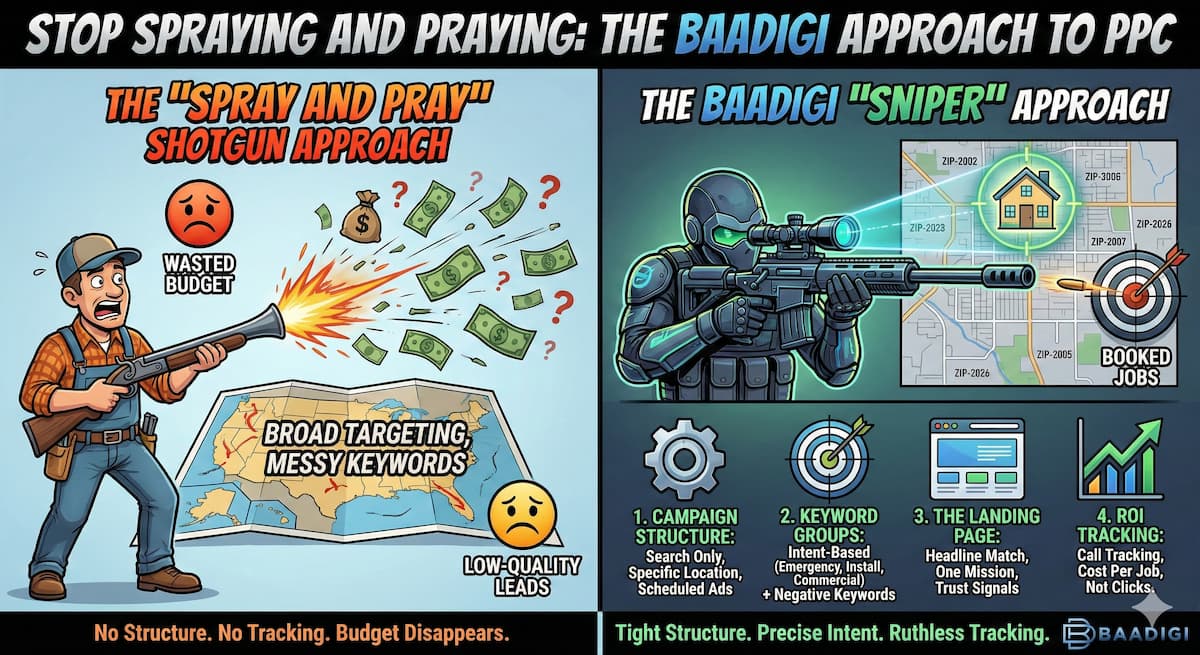
In the military, you don’t just fire in the general direction of the target; you take a sniper‑level shot. In roofing PPC, most contractors do the opposite—they run “shotgun” campaigns with broad targeting, messy keywords, and no real tracking, then wonder why their budget disappears. To dominate your local market, you need a sniper approach: tight structure, precise intent targeting, and ruthless tracking of cost per lead and cost per job. At Baadigi, we’ve managed significant ad spend for roofing companies, and this is the framework we use to turn clicks into booked jobs.
1. Campaign Structure: The Foundation of Victory
Most roofing campaigns fail before the first ad is written because the account settings are wrong.
- Network settings: Run a Search campaign only and turn OFF the Display Network and Search Partners so you avoid low‑quality placements and accidental clicks on random sites or mobile apps.
- Location targeting: Don’t target the entire metro by default—target the specific zip codes where your best customers live, and use “Presence” (people in your location) instead of interest‑based options that pull in out‑of‑area traffic.
- Ad schedule: Only run ads when someone can answer the phone or respond quickly; paying for a click at 2 a.m. when no one responds is wasted spend and hurts your conversion rate metrics.
2. Keyword Groups: Intent Is Everything
Throwing “roof repair,” “commercial roof,” and “metal roofing” into the same ad group makes your ads vague and hurts Quality Score. Instead, group keywords by intent and value:
- “Alpha” ad groups:
- Emergency/Repair – terms like “emergency roof repair,” “roof leak repair,” “storm damage roofer” (high urgency, lower ticket but fast cash flow).
- Replacement/Install – terms like “roof replacement company,” “new roof estimate,” “metal roof installation” (lower urgency, higher ticket).
- Commercial – terms like “flat roof repair,” “TPO roof repair,” “commercial roof replacement” (longer cycle, high value).
- Competitor campaigns: It is a common and generally allowed tactic to bid on competitor brand names as keywords (without using their trademarks in your ad text) to capture prospects comparing options.
The secret weapon: negative keywords
Negative keywords are how you tell Google what you don’t want, and they can save local roofers thousands per year. Build and maintain a negative list that includes terms like “jobs,” “salary,” “employment,” “DIY,” “free,” “tools,” “supplies,” “Home Depot,” and “Lowe’s,” so you’re not paying for job seekers or do‑it‑yourselfers.
For match types, most local roofers should start with exact and phrase match keywords plus strong negatives, then only test broad match later—if you’re using Smart Bidding and already have consistent conversions—because broad match can expand to loosely related searches and waste budget when data is thin.
3. The Landing Page: Where the War Is Won
If your ad promises “Emergency Roof Leak Repair” but you send people to a generic homepage with every service you offer, you lose the homeowner’s attention in seconds. Instead, build a dedicated landing page for each main intent:
- Headline match: The headline on the page should mirror the main promise from the ad (“Emergency Roof Leak Repair in [City] – 24/7 Service”).
- One mission: Strip out top navigation and distractions so the visitor has two obvious options: call you or submit the form.
- Trust signals: Place your Google star rating, “Licensed & Insured” badge, reviews, and warranties next to your phone number and form to reduce friction and make calling you feel safe.
If your website isn’t turning paid traffic into leads at double‑digit percentages, it’s just digital wallpaper—pretty, but not profitable.
Is your own website costing you leads?
Free scan — speed, mobile, local visibility, and lead capture. Results in about 30 seconds.
4. ROI Tracking: Clicks Are Cool, Calls Are Better
You can’t improve what you can’t measure.
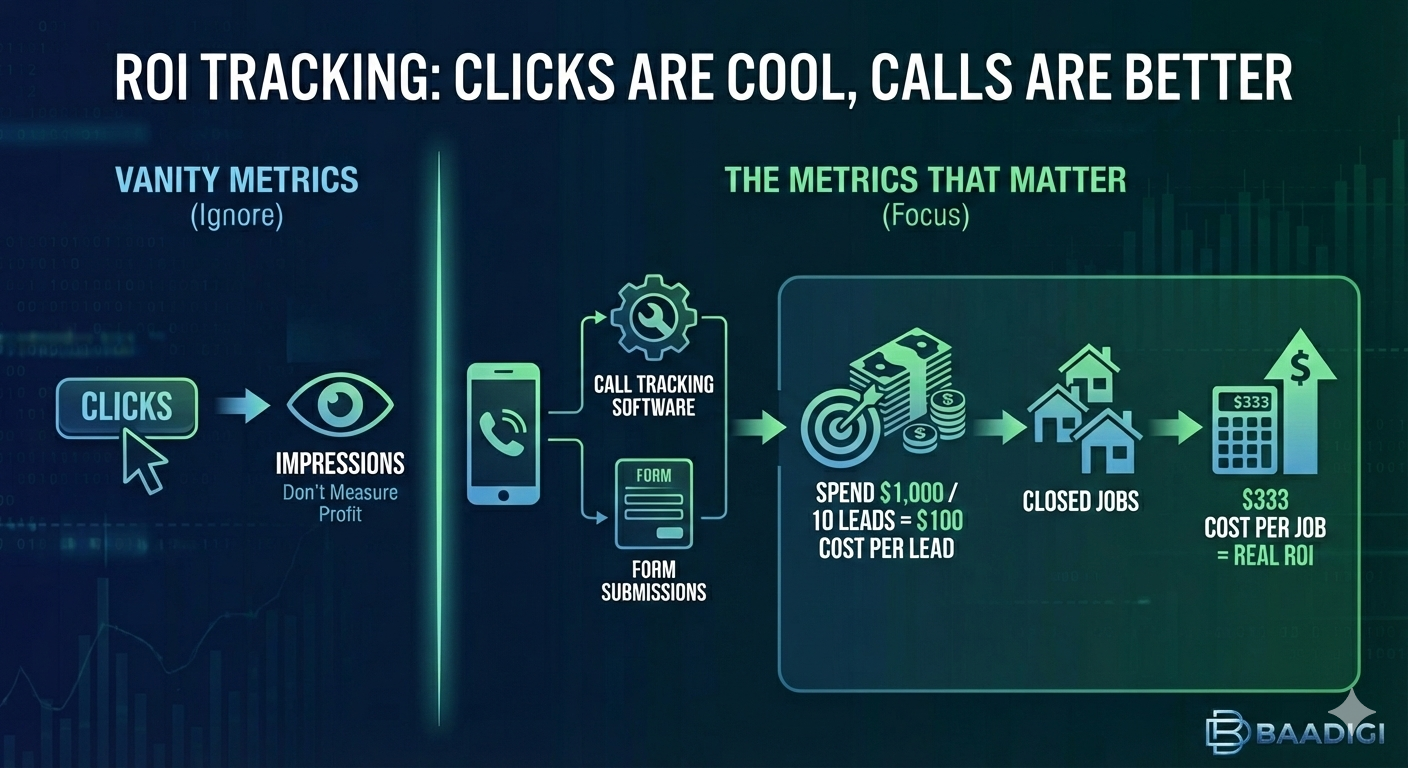
- Conversion tracking: Use Google Tag Manager or native tracking to log form submissions, button clicks, and key actions as conversions in Google Ads.
- Call tracking: Use call‑tracking software (such as CallRail or an integrated VoIP solution) to track which campaigns and keywords are generating phone calls, not just sessions.
- The metric that matters: Ignore vanity metrics like impressions and focus on cost per conversion and cost per acquisition (CPA). If you spend $1,000 to generate 10 leads, your cost per lead is $100; if you close 3 of those into jobs, your cost per job is about $333—numbers you can compare directly with your average job profit.
National FAQs
How much budget do I need to start Google Ads for roofing?
For most single‑territory roofing campaigns, a starting budget of $1,500–$3,000 per month is realistic enough to generate data and optimize performance. In highly competitive markets, you may need more, and anything much under roughly $50/day usually spreads clicks too thin to see consistent results.
What is a “Quality Score” in Google Ads and why does it matter?
Quality Score is Google’s 1–10 rating of the relevance and expected performance of your keywords, ads, and landing pages. When your ad copy closely matches your keywords and leads to a highly relevant, fast‑loading landing page, your Quality Score improves, which can lower your cost per click compared to competitors in the same auction.
Should I use “Broad Match” keywords?
For most roofing companies, especially when you’re starting out, it’s safer to begin with exact and phrase match keywords combined with strong negatives so you stay close to the homeowner’s actual intent. Broad match can work later when you have solid conversion data and are using Smart Bidding, but by default it allows Google to match to loosely related terms, which can waste budget in small local markets.
How do I stop competitors from clicking my ads?
You can’t completely prevent competitors from clicking, but Google automatically filters many invalid or repeated clicks and refunds them when detected. On top of that, specialized click‑fraud tools can flag suspicious patterns, block abusive IPs from seeing your ads, and provide evidence if you need to escalate a click‑fraud issue.
Is Google Ads better than SEO for roofers?
Google Ads and SEO solve different problems: Ads can put you at the top of search results and start generating calls within days, while SEO usually takes months but can drive ongoing “free” traffic once rankings are earned. The most resilient roofing companies run both, using PPC and possibly Local Services Ads for immediate volume and SEO to lower long‑term acquisition costs.
What is the average conversion rate for roofing PPC?
Industry data suggests the average roofing PPC conversion rate can hover in the low single digits, but well‑optimized campaigns and landing pages often reach 10–20% visitor‑to‑lead conversion on high‑intent traffic. If you’re seeing under about 5%, it usually means your targeting, offer, or landing page experience needs serious work.
Ready to Deploy the Sniper Strategy?
You now have the technical blueprint to stop wasting budget on "shotgun" marketing, but executing a high-intent campaign requires constant vigilance. To explore more ways to fill your pipeline beyond just PPC, read our comprehensive roofing leads guide for 2026. However, if you are ready to stop guessing and start generating exclusive leads that are never resold, let us handle the heavy lifting.
Call Baadigi today at (714) 707-2483.
Keep Reading:
- Roofing Lead Generation: The Complete 2026 Guide
- SEO for Contractors — How we rank roofers #1 in their service area
- PPC Advertising for Contractors — Google Ads + LSA management
- The Predictable Work Engine™ — Our complete lead-to-job system
Free website audit — see what's costing you leads
No email required. Takes 2 minutes. Completely free.

Ryan Goering
CEO & Founder, BaaDigi
U.S. military veteran and digital marketing strategist who built BaaDigi to help contractors generate predictable leads and revenue. 15+ years in SEO, PPC, and AI-powered marketing automation.
Frequently Asked Questions
How much budget do I need to start Google Ads for roofing?▼
A starting budget of $1,500-$3,000 per month is realistic for most single-territory roofing campaigns. Anything under roughly $50/day spreads clicks too thin to see consistent results. Highly competitive markets may require more.
What is a Quality Score in Google Ads and why does it matter for roofers?▼
Quality Score is Google rating of your keyword, ad, and landing page relevance. A higher score lowers your cost per click compared to competitors in the same auction, meaning better positioning at a lower cost when your ads match your landing pages.
Should I use Broad Match keywords in roofing Google Ads?▼
For most roofers, start with exact and phrase match keywords plus strong negatives to stay close to homeowner intent. Broad match can work later with solid conversion data and Smart Bidding, but risks wasting budget on loosely related terms in small local markets.
Is Google Ads better than SEO for roofers?▼
They solve different problems. Google Ads puts you at the top of search results and generates calls within days, while SEO takes months but drives ongoing traffic once rankings are earned. The most resilient roofing companies run both — PPC and LSAs for immediate volume, SEO to lower long-term costs.
What is the average conversion rate for roofing PPC?▼
Well-optimized campaigns and landing pages often reach 10-20% visitor-to-lead conversion on high-intent traffic. If you are seeing under 5%, your targeting, offer, or landing page experience needs serious work.
How do I stop competitors from clicking my roofing Google Ads?▼
You cannot completely prevent it, but Google automatically filters many invalid clicks and refunds them. Specialized click-fraud tools can flag suspicious patterns, block abusive IPs, and provide evidence if you need to escalate the issue.
Popular Contractor Marketing Guides
PPC for Contractors by City
We serve contractors nationwide — based in Orange County, CA
Explore More Topics
Ready to Get More Leads?
Get a free marketing audit for your contracting business. We'll show you exactly where you're losing leads.
Get Your Free AuditRelated Articles
How to Get Auto Detailing Leads Without Buying Them
Build a lead source you own instead of renting shared leads — with the real cost-per-lead numbers behind every channel.
Networx Leads: Honest Contractor Review
Honest review of Networx Leads for contractors — pricing, lead quality, what trades it fits, complaint patterns, and the better long-term alternative.
Service Direct Leads: Real Contractor Review
Honest contractor review of Service Direct — exclusive pay-per-call pricing, how it works, who it fits, complaint patterns, and the better long-term alternative.