How to Use Automated Calling Services to Follow Up on Roofing Leads (The "Speed-to-Lead" Hack)

Speed-to-Lead Essentials: How Instant Connect Works
What is automated calling for lead follow‑up?
Automated calling for lead follow‑up (often called “instant connect” or “bridge calling”) is a system that instantly alerts your team and triggers a call the moment a homeowner submits a form or lead. The system first calls your salesperson, then, once they pick up, automatically dials the homeowner and connects both live on the same call—usually in under 30–60 seconds.
Why is automated calling crucial for roofing leads?
Speed is one of the biggest predictors of whether a roofing lead turns into a booked appointment. Multiple studies show that leads contacted within about five minutes are many times more likely to convert than those contacted 30+ minutes later, and automated calling removes human delay so you reach homeowners while they’re still on your site and thinking about their roof.
Is automated calling the same as robocalling?
No. Robocalling typically means blasting pre‑recorded messages to cold lists, which is heavily regulated and often illegal without proper consent. Automated lead follow‑up connects two real humans—your rep and a homeowner who just requested information—using software in the background to speed up the connection, which is compliant when you have proper consent and respect opt‑out rules.
The 5‑Minute Rule: Why Manual Follow‑Up Is Killing Your ROI
In the digital battlefield for roofing leads, “slow is dead.” Studies on speed‑to‑lead consistently show that companies responding within minutes are dramatically more likely to reach and qualify a lead than those waiting half an hour or more. For roofers, the stakes are even higher: homeowners with roof leaks or storm damage usually contact several contractors and often book with the first one who answers the phone and sounds competent.
If you wait for an email notification, finish what you’re doing, and then maybe call back 30–60 minutes later, there’s a good chance a faster competitor already booked the inspection. Automated calling flips this—your team is talking to the homeowner while they still have your page open and before they start dialing every roofer in town.
How the “Instant Connect” Protocol Works
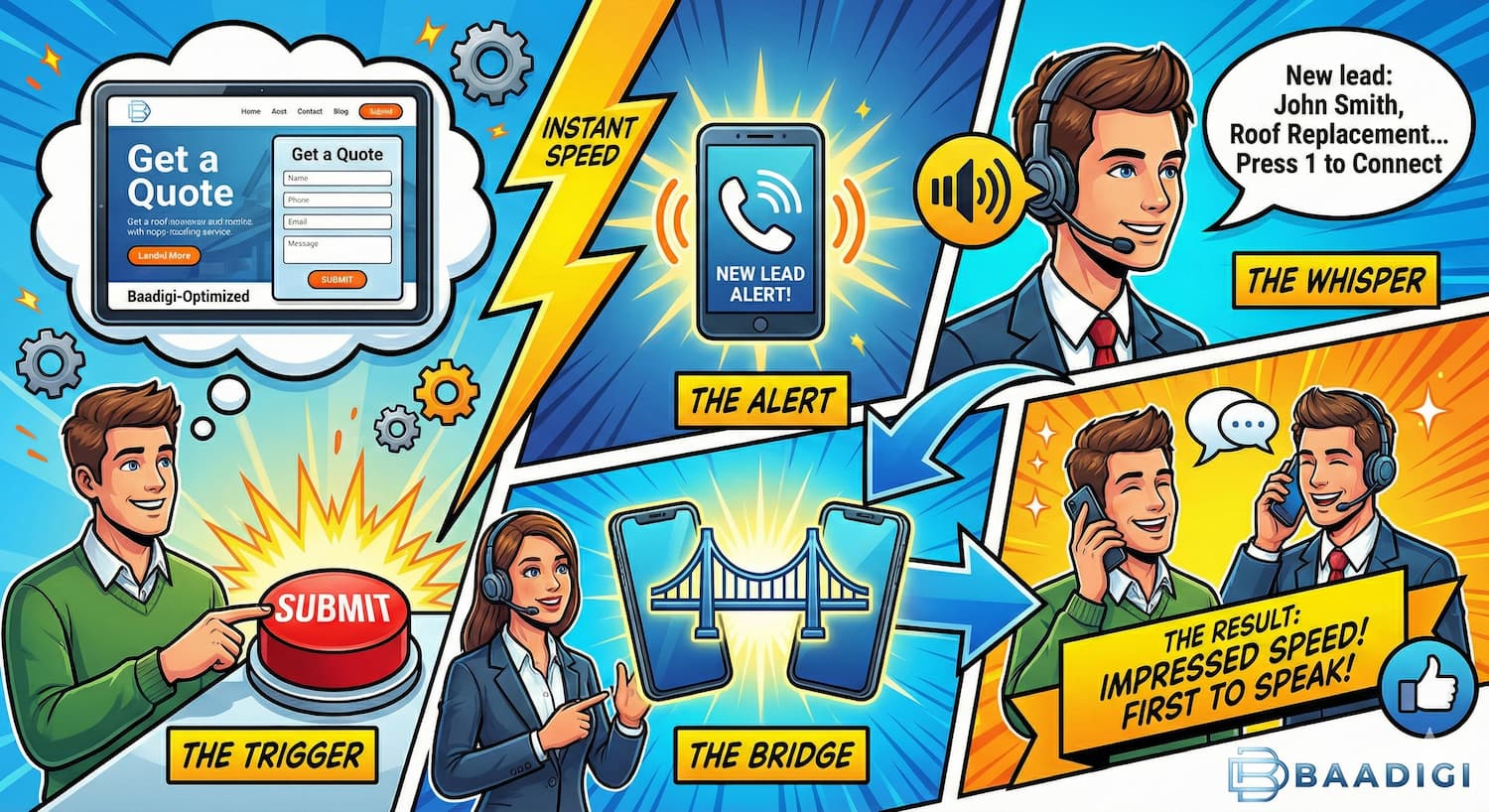
This isn’t about robots talking to your customers; it’s about using automation to get a human on the phone faster. Here’s the basic workflow Baadigi implements for high‑volume roofing clients:
- The trigger: A homeowner fills out a “Get a Quote” or “Free Inspection” form on your Baadigi‑optimized landing page.
- The alert: Within seconds, your sales manager’s or dispatcher’s phone rings with a new lead notification.
- The whisper: A short “whisper message” (only your rep hears it) plays: “New lead: John Smith, roof replacement in [City]. Press 1 to connect.”
- The bridge: When your rep presses 1, the system automatically dials the homeowner and bridges the two calls together.
- The result: The homeowner gets a call moments after clicking “Submit,” is impressed by the speed, and you become the first roofer they actually speak to.
Beyond the Call: SMS and Voicemail Automation
Not every homeowner answers the phone on the first attempt, even if you call quickly.
- Automated SMS: If the call goes unanswered, the system can automatically send a personalized text like, “Hi [Name], this is [Rep] from [Company]. I just tried calling about your roof quote—when is a good time to talk today?”
- Ringless voicemail: Some systems allow a pre‑recorded voicemail to be dropped into the prospect’s inbox without ringing their phone, giving them a friendly, non‑intrusive message to call back when convenient.
Layering calls with SMS and voicemail follow‑up helps you reach busy homeowners without your team manually chasing every lead.
The Compliance Criticality (TCPA)
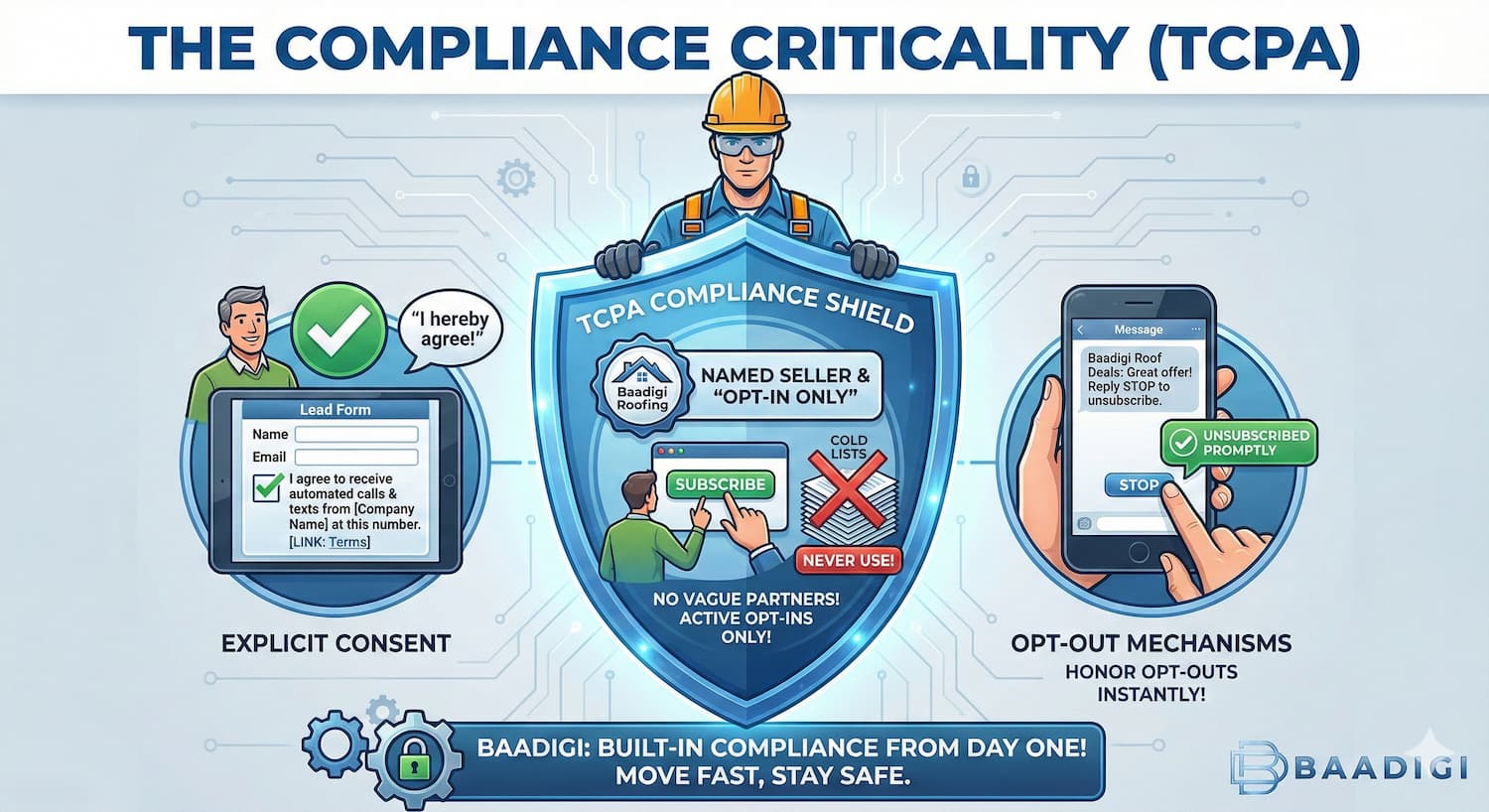
This is where many inexperienced marketers get into trouble. To safely use automated dialers, texts, and voicemail drops in the U.S., you must comply with the Telephone Consumer Protection Act (TCPA) and recent FCC updates.
- Explicit consent: Your lead forms should clearly state that by submitting the form, the consumer agrees to receive calls and texts from your company at the number provided, and, where applicable, that these may use automated dialing or pre‑recorded messages.
- Named seller & “opt‑in only”: You must be explicitly named on the form (no vague “partners”), and you should only use automated calling and texting on leads who have actively opted in—never on purchased cold lists.
- Opt‑out mechanisms: Every marketing text should include a clear “STOP to unsubscribe” or similar instruction, and your systems must honor opt‑outs promptly.
At Baadigi, compliance isn’t bolted on later—it’s built into our funnels and forms from day one, so you can move fast on follow‑up while staying aligned with evolving TCPA rules.
National FAQs
Does automated calling sound like a robot to the customer?
No. With instant‑connect systems, all of the automation happens behind the scenes, before the customer picks up. From the homeowner’s perspective, it simply feels like your office called them back almost immediately after they requested a quote, and the conversation itself is between two real people.
What happens if a lead comes in at 2 a.m.?
Modern automation platforms let you define business hours so you’re not waking people—or your team—up in the middle of the night. If a lead submits a form after hours, the system can send an automatic text confirming receipt and then queue the bridge call for the start of the next business day.
Can I use automated calling for old leads?
You can use automation to re‑engage old leads through database reactivation campaigns (texts, emails, and, where permitted, voicemail drops) to see who’s still interested. However, bridge‑style instant calling is most effective for fresh, inbound leads so you don’t irritate past prospects who may have already chosen another contractor or opted out.
How much does automated lead follow‑up software cost?
Standalone lead‑response and call‑automation tools typically range from around $100 to several hundred dollars per month, depending on features and call volume. Many advanced digital marketing partners bundle these tools into their service packages so roofers don’t have to purchase, connect, and manage separate systems on their own tech stack.
Will this annoy the customer?
When done properly, the opposite is usually true. Studies show most modern buyers expect fast responses—often within 5–10 minutes—to online inquiries, and they get frustrated having to wait hours or days. For homeowners who just asked for a roof quote, an immediate, polite phone call is typically perceived as excellent service and responsiveness, not spam.
Does this integrate with my CRM (HubSpot, JobNimbus, AccuLynx, etc.)?
Yes. Most modern calling and lead‑response platforms integrate with major CRMs and roofing‑specific systems via native integrations or APIs. That means calls, texts, notes, and outcomes can be logged automatically on the contact record, giving you a full history of each conversation without manual data entry.
Fuel Your Automation with Exclusive Leads
Mastering the “speed-to-lead” game ensures you convert more of the opportunities you receive, but even the best automation needs a steady stream of prospects to work effectively. If you are ready to fill your funnel with homeowners and property managers who actually want to talk to you, read our complete 2026 guide to generating exclusive, high-quality commercial and residential jobs. It covers the specific strategies you need to keep your automated dialers busy and your sales team closing.
Contact BaaDigi today at 714-707-2483 to learn more about our lead generation services for roofing contractors.
Free website audit — see what's costing you leads
No email required. Takes 2 minutes. Completely free.

Ryan Goering
CEO & Founder, BaaDigi
U.S. military veteran and digital marketing strategist who built BaaDigi to help contractors generate predictable leads and revenue. 15+ years in SEO, PPC, and AI-powered marketing automation.
Popular Contractor Marketing Guides
Explore More Topics
Ready to Get More Leads?
Get a free marketing audit for your contracting business. We'll show you exactly where you're losing leads.
Get Your Free AuditRelated Articles
Local Service Ads (LSAs) for Remodeling Leads: Setup, Optimization, and Lead Handling
Google Local Service Ads put remodelers at the very top of search results with a Google Guarantee badge. Here's how to set them up and win.
How Much Do Contractor Leads Cost? "By Trade"
Contractor lead costs vary dramatically by trade, from $20 for basic plumbing leads to $300+ for roofing. Understanding these costs and how to calculate your maximum affordable cost per lead is crucial for profitable marketing campaigns.
Home Addition & Whole-Home Remodeling Leads: Landing the Big-Ticket Jobs
Big-ticket remodeling jobs don't come from the same playbook as kitchen and bath leads. Here's how to attract $50k-$500k+ home addition projects.