
Support center (714) 707-2483
Writen by Ryan R Goering
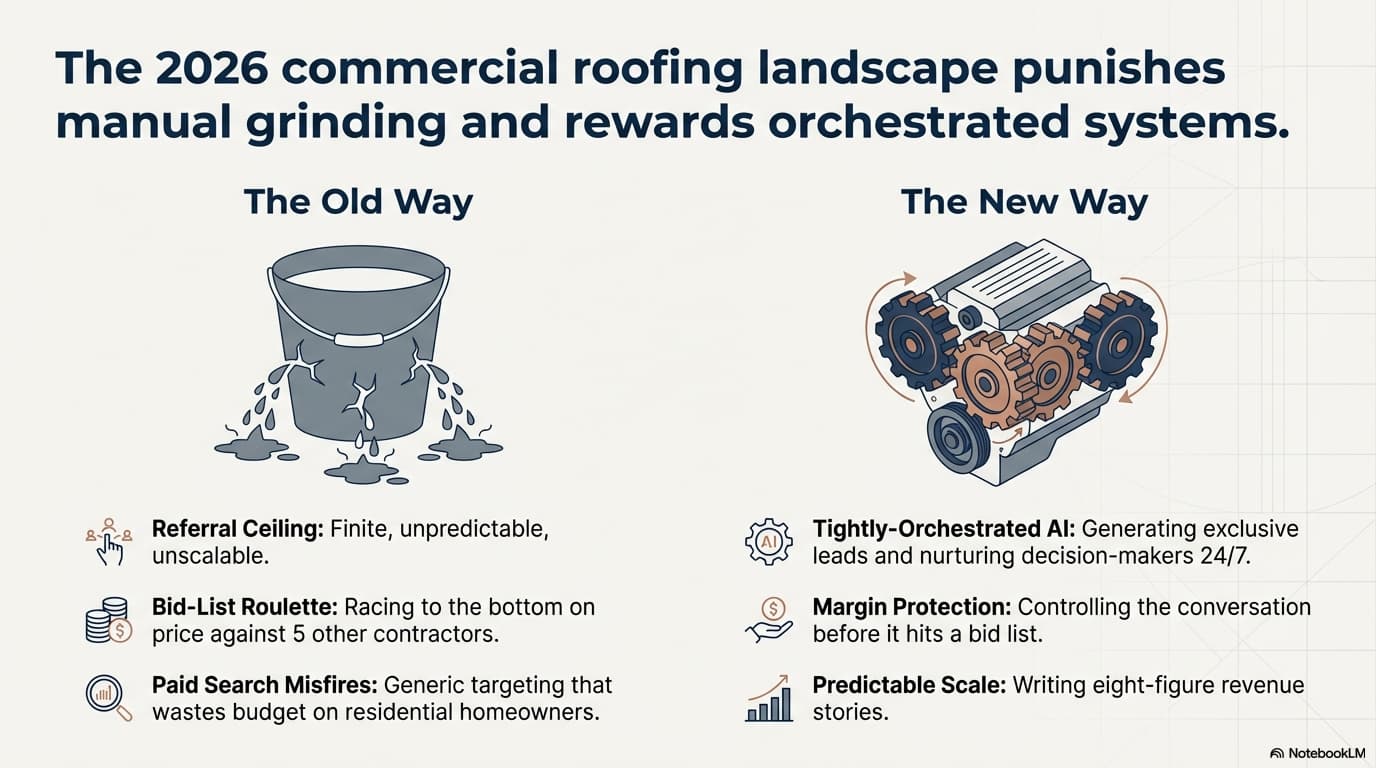
In 2026, the biggest wins in commercial roofing don't come from door-knocking or random bids. They come from a tightly-orchestrated AI prospecting engine — one that generates qualified leads, nurtures decision-makers, and feeds a CRM pipeline that keeps your team focused on closing. The contractors still relying on referrals and the old bid-list grind are watching their margins compress. The ones building AI acquisition systems are writing eight-figure revenue stories.
This article walks through exactly how I'd build a commercial roofing business from scratch today — starting with zero brand recognition and zero referrals — with a single target: $400,000 per month in commercial projects. Every strategy here is one that BAADIGI designs and installs for commercial roofing companies that want predictable, scalable, high-ticket revenue
This is the commercial deep-dive companion to our flagship resource: The Complete 2026 Guide to Generating Exclusive, High-Quality Commercial and Residential Roofing Jobs. That guide covers the full lead generation ecosystem across both residential and commercial. This article goes narrow and deep on the commercial side only — the ICPs, the AI channels, the exact stack, and what BAADIGI installs.
Want to see how the full system would look in your specific market? Book a free Commercial AI Roofing Blueprint Call with BAADIGI →
Most contractors build a marketing strategy by picking tactics — SEO, Google Ads, LinkedIn — without ever working backward from a clear revenue goal. That approach produces activity, not outcomes. The fix is simple: start with the math.
Commercial roofing job sizes vary widely by market, building type, and scope. A realistic working range for mid-market commercial projects — office parks, industrial warehouses, retail centers, schools, churches, HOA common-area buildings — is $50,000 to $150,000 per job. At that range, hitting $400,000 per month looks like this:
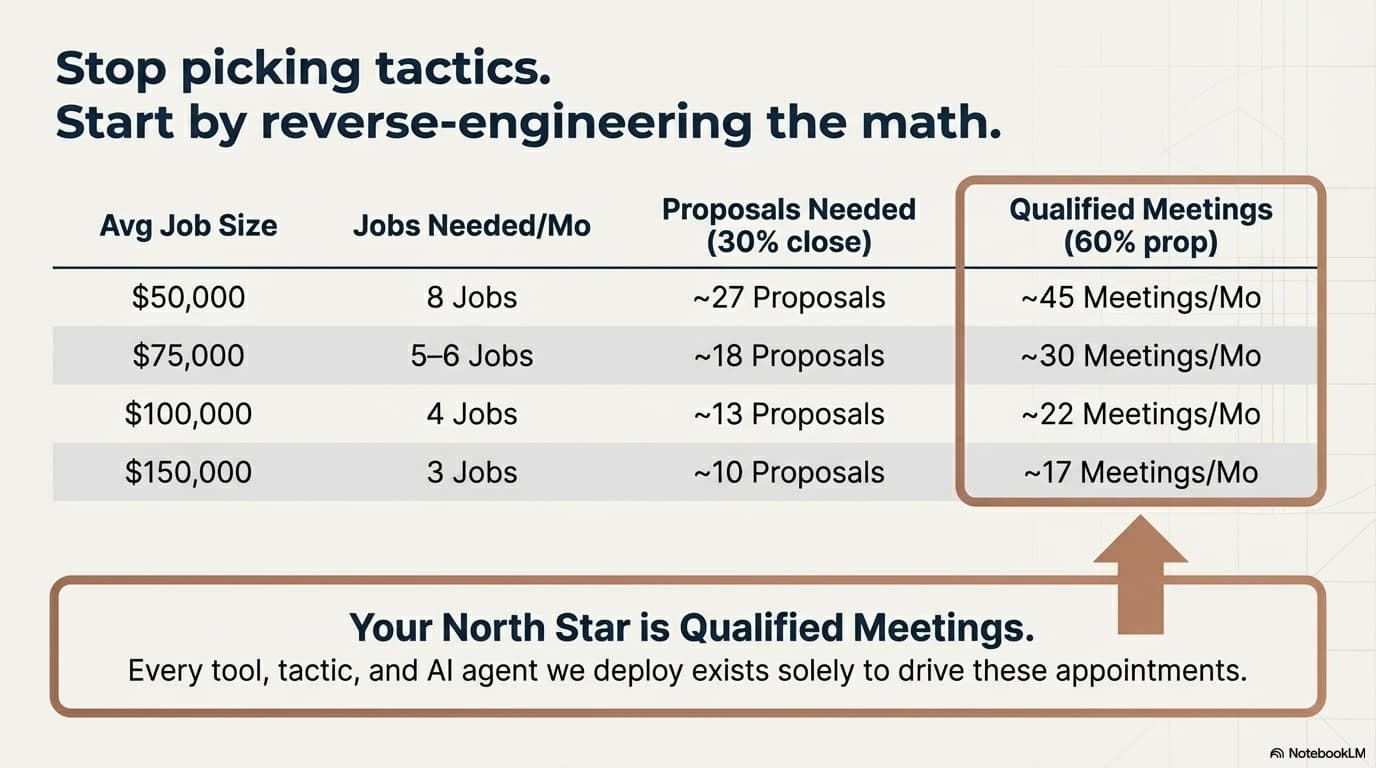
The number of qualified meetings per month is your North Star. Every tool and tactic in this guide exists to drive those meetings with commercial decision-makers. Use it as your filter for every investment and every activity.
Referrals are the lifeblood of most roofing businesses — until they aren't. Referral networks are inherently finite, unpredictable during slow seasons, and completely incapable of scaling to a specific revenue target without a systematic engine underneath them.
"Google Ads don't work for commercial roofing" is one of the most common complaints from contractors who tried paid search and abandoned it. They're not entirely wrong — but the failure is almost always wrong intent targeting, wrong keyword selection, and wrong landing pages. Commercial roofing buyers search with different language, different roles, and different decision timelines than residential homeowners.
If you're currently using shared lead providers or pay-per-lead services, read this first: 3 Affordable Roofing Lead Providers Offering Pay-Per-Lead Pricing — and One Better Alternative. It explains exactly why shared leads underperform and what a better model looks like.
Inbound SEO is the only channel in commercial roofing where qualified decision-makers come to you. Every other channel in this guide involves going out and finding people. SEO reverses the dynamic — it positions you as the obvious answer when a property manager or facility director is already searching for exactly what you do. Done right, it operates as a 24/7 lead generation machine that compounds over time.
Commercial roofing searches fall into distinct intent buckets that require different content approaches. The mistake most contractors make is building one generic 'commercial roofing' page and hoping it ranks for everything. It won't — and even if it did, the conversion rate on a generic page is weak because different commercial buyers have different problems.
The search landscape segments by building type, roof system, problem urgency, and buyer role. A property manager for a portfolio of strip malls searches differently than a school district facilities director or a church board budgeting a replacement. Your content needs to speak to each of them specifically.
📖 Read First: Roofing Leads Guide 2026 — Every Lead Generation Channel Ranked by ROI and Difficulty
The traditional approach to building a commercial SEO content library takes 6–12 months of manual copywriting. In 2026, AI compresses that timeline to weeks — but only if it's deployed strategically with genuine technical input, not just producing generic content at volume.
BAADIGI uses AI to draft high-specificity landing pages that would otherwise require weeks of research and writing per page. The AI accelerates production; our team edits for local accuracy, technical specificity, and brand voice before anything goes live.
BAADIGI maps your service mix, territory, and competitive landscape into a keyword blueprint — a structured document showing exactly which pages to build, in what order, targeting which terms, with which CTAs. From that blueprint, we build:
The result: a commercial-focused web presence capable of ranking and converting in weeks, not the months of manual effort a traditional agency would require.
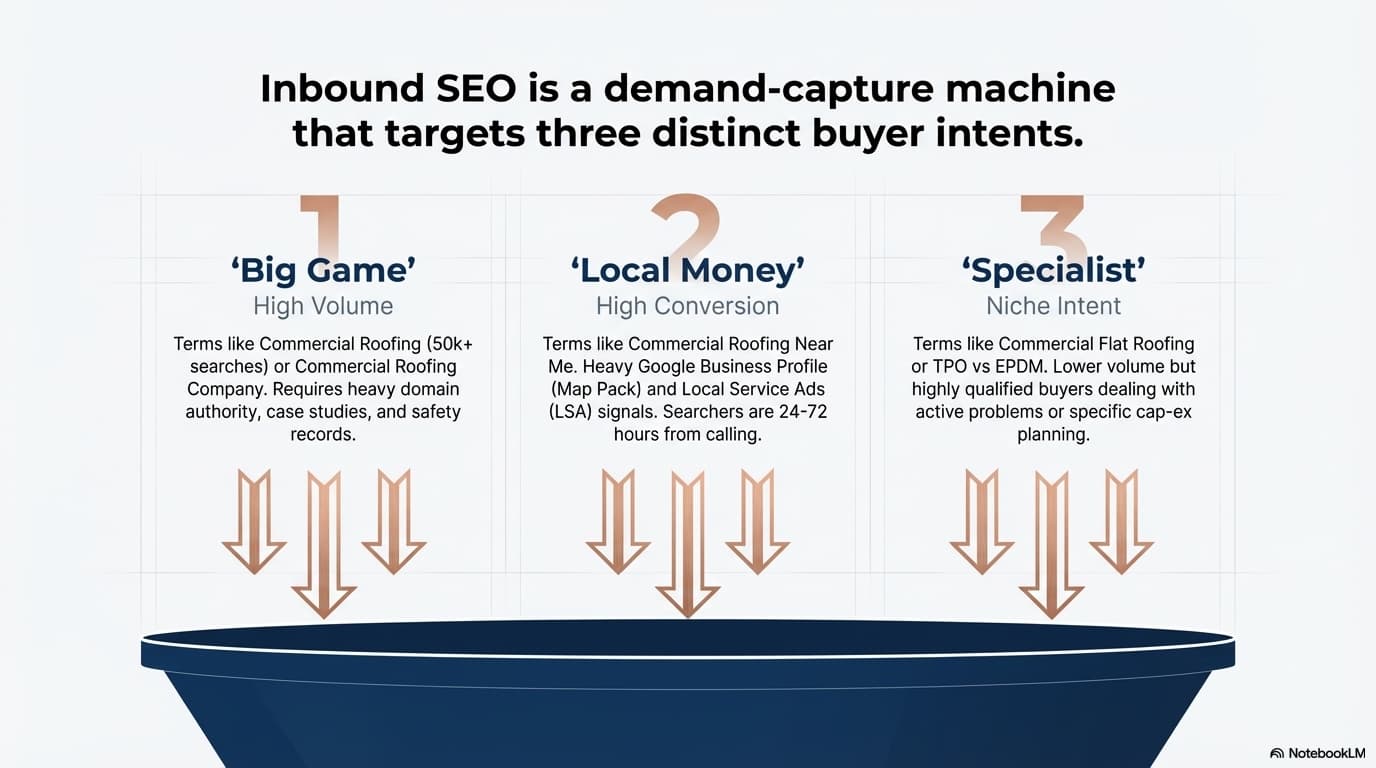
These terms represent the largest search volume and the highest competition. They require real domain authority and well-built pages to rank, but once established they deliver consistent, high-intent traffic.
These terms carry hyper-local intent and the highest correlation to immediate hire decisions. A property manager typing 'commercial roofing near me' is typically 24–72 hours from calling someone.
Google Local Services Ads (LSA) sit above both Maps and organic results for 'near me' and city-level searches — making them a critical complement to your organic SEO. For the full LSA setup and optimization playbook, read: How to Generate Roofing Leads Through Local Service Ads (Google LSA) — The 2025 Playbook.
Lower volume, extremely specific buyer intent — and often the best-converting terms in the entire funnel.
BAADIGI creates focused sub-pages for each service type with technical content, project photos, FAQs, and conversion points that qualify the visitor before they ever fill out a form.
'Commercial Roofing' looks compelling with 50k+ monthly searches — but the fastest ROI consistently comes from 'commercial roofing company,' 'commercial roofing contractors,' and 'near me' variations, because those searchers want to hire, not just research.
BAADIGI prioritizes hiring-intent phrases first in every build, then expands to broader and educational terms as an authority moat once the conversion foundation is solid.
SEO captures buyers who are already searching. LinkedIn lets you find and engage commercial decision-makers before they start searching — which means you can get to them before any competitor does. In commercial roofing, the decision-maker is almost never the property owner sitting at home. It's a property manager, facility director, asset manager, or a committee. LinkedIn is where those people spend professional time.
Before any AI agent can find the right people, you need a precise ICP definition. Vague targeting — 'anyone who manages buildings' — produces low-quality conversations and wasted outreach budget. Commercial roofing decisions are made by specific people in specific roles with specific portfolio characteristics.
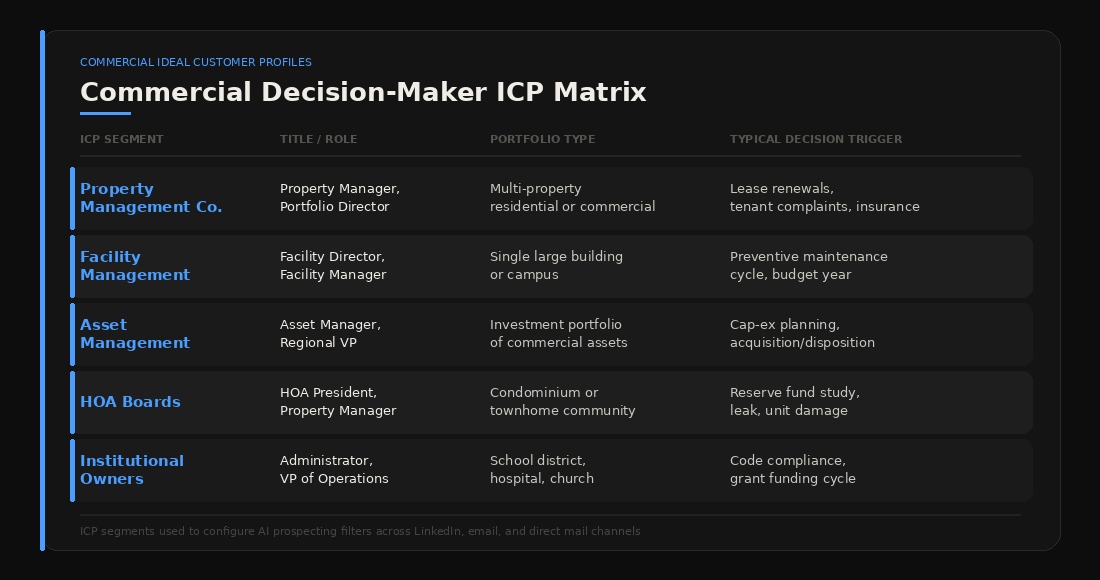
BAADIGI works with you to define your primary and secondary ICP segments based on your market, service capabilities, and existing customer portfolio. The more specific the ICP, the more effective the AI prospecting logic.
A LinkedIn AI prospecting agent — built on top of LinkedIn Sales Navigator and enriched with data platforms like Apollo.io — runs a continuous search against your ICP criteria and delivers a regularly refreshed list of high-fit commercial decision-makers in your service territory. This isn't cold-emailing a purchased list. It's a systematically maintained pipeline of qualified prospects.
The AI doesn't just find prospects — it drafts the outreach. Connection requests and follow-up messages are written with context pulled from each prospect's role, company, building type, and relevant pain points. The message reads like it was written specifically for that person — because the data it's built on was.
BAADIGI configures the full LinkedIn prospecting stack: ICP filter logic, prospect scoring, message sequence templates, and the integration between LinkedIn workflow and your GoHighLevel CRM. When a prospect replies, their record is auto-created in your pipeline with the full conversation history attached. When they book, it appears on your calendar and a follow-up task is created automatically.
Not every commercial roofing opportunity announces itself through search or LinkedIn. Many of the highest-value conversations happen in Facebook groups, local business owner communities, CRE investor forums, and landlord groups — in plain sight, with none of your competitors monitoring them. A property manager posting 'our flat roof has been leaking for two weeks and our contractor keeps rescheduling' is a live, high-urgency commercial opportunity. An AI social listening agent sees it the moment it appears.
KEYWORD TRIGGERS — SOCIAL LISTENING AGENT
Roof leak | Flat roof | TPO | EPDM | Metal roof | Water intrusion
Insurance claim | Roof replacement | Maintenance contract | Adjuster
Property manager | Facility maintenance | Commercial property
Need a roofer | Roofing contractor recommendation | Who do you use for roof
Cap-ex | Reserve fund | Roof inspection | Condition report
The conversion framework moves through three stages: value in public, qualified curiosity in DM, clear offer in follow-up.
Value in the Comments: When the agent flags a relevant post, a human-approved response provides immediate value — a quick diagnostic, a mini-checklist, or specific next steps the poster can take regardless of who they hire. Positions you as the expert, not the vendor.
AI-Drafted DM Follow-Up: The agent drafts a private follow-up referencing the specific post and offering something concrete: a free roof condition report, a budget estimate framework, or a 15-minute call. You review and send.
CRM Logging: The moment the conversation moves to DM, the contact is tagged and logged in GoHighLevel with the full thread, the source group, and the triggering offer attached to the record.
Automated Follow-Up: If the DM doesn't convert to a meeting within 48 hours, an automated sequence picks up — built around the specific problem they described in the post.
BAADIGI identifies the highest-value groups in your market, configures keyword monitoring logic, and builds the response template library. The social listening workflow connects directly to your GoHighLevel pipeline — so every opportunity discovered through group monitoring enters the same system as your SEO leads, LinkedIn contacts, and email responses.
Direct outreach to a curated target list is one of the most reliable ways to generate commercial roofing meetings — particularly when the outreach is specific, sequenced, and professional. AI collapses the time required to build a good list and write relevant messages from months to days.
The Dream 100 concept means identifying the specific properties and organizations where, if you landed the account, it would meaningfully change your business. For commercial roofing, this is a specific, addressable list of buildings in your service territory.
Tools like Apollo.io and Hunter.io help aggregate property manager and facilities director contact information — names, business emails, postal addresses, and LinkedIn profiles — against commercial property data in your market.
📖 Related Reading: How to Buy Exclusive Roofing Leads for Your Local Area Without Competing With Other Roofers
The reason most cold email fails for commercial roofing is generic targeting. An email saying 'We're a local roofing company serving your area' gets deleted unread. An email referencing a specific building type, a local weather event, or a recently completed project nearby gets a second look.
AI personalizes at scale by pulling in property-specific data — building type, roof system if available from permit records, proximity to recent completed jobs, and market-specific risk factors — to produce emails that read like they were written for a specific recipient.
EXAMPLE AI-PERSONALIZED OUTREACH EMAIL
Subject: Roof condition at [Property Name] — quick question
Hi [First Name],
We recently completed a TPO restoration at a retail plaza on [Nearby Street] and noticed [Property Name] has a similar flat roof system from the same era.
Flat membranes installed in that period typically hit their maintenance window right about now, and with [season/weather event] coming up, a quick condition check can prevent a significantly larger budget problem.
We offer a free, no-obligation roof condition report — a documented assessment of current status, expected lifecycle, and budget range for anything we find. No sales pitch, just a useful document to have on file.
Would that be worth 45 minutes of your roof access? Happy to work around your schedule.
[Name] | [Title] | [Company] | [Phone]
Physical mail still works — particularly for commercial property managers who receive very little physical outreach from roofing contractors. An AI-personalized letter on a desk is tangible in a way a cold email never is.
If you're evaluating whether to build your own outbound list or supplement it with purchased leads, this comparison is worth reading: How to Buy Exclusive Roofing Leads Without Competing With Other Roofers.
BAADIGI builds your Dream 100 target list, cleans and enriches the data, sets up the AI personalization workflow, and creates the full campaign asset library. All campaign responses — email replies, web form submissions, QR scans — route directly into your GoHighLevel pipeline for structured follow-up. Nothing falls through the cracks.
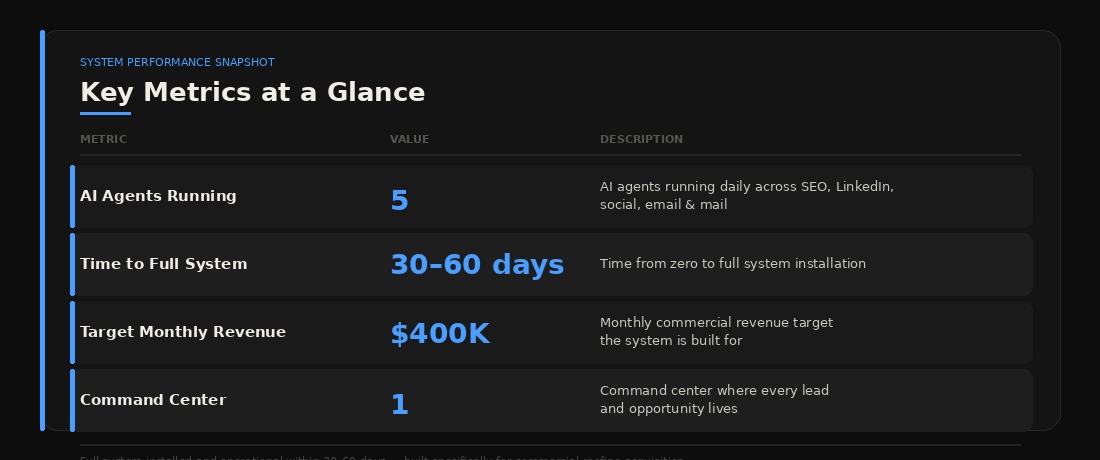
Think of what we've built so far as a virtual team — five specialized agents, each with a specific role, running daily and weekly operations that your human team reviews, approves, and closes on. No salary overhead. No sick days. No slow weeks.
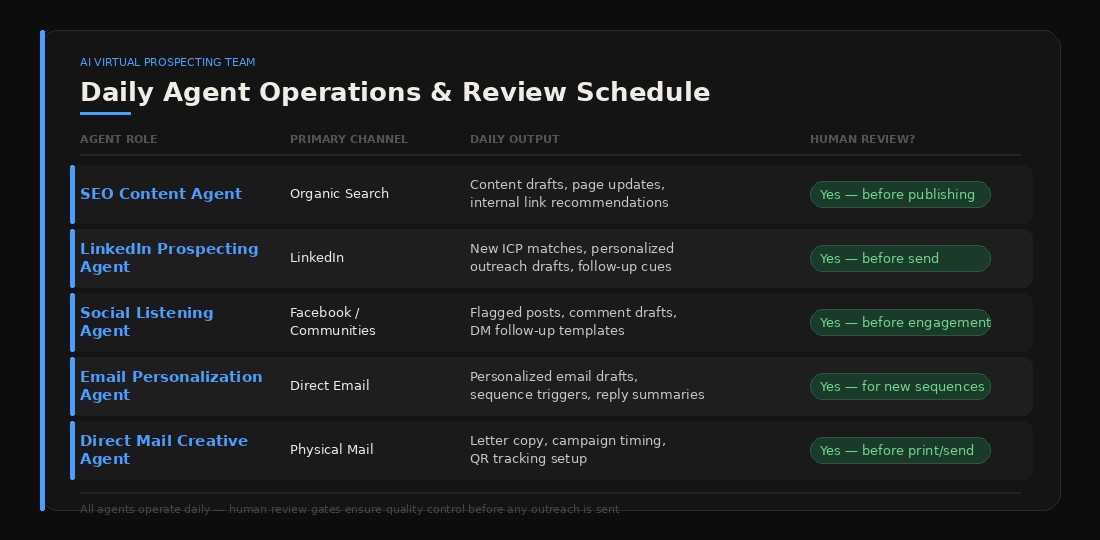
The reason most contractors fail at AI prospecting is that they try to learn, configure, and manage every platform themselves — which is a full-time job. BAADIGI orchestrates the entire system: the AI tools, the data connections, the CRM integration, and the workflow logic. We deliver a single, simple daily review process for your team. Your job is to review, approve, and follow up on booked meetings. Our job is to make sure those meetings are showing up consistently.
GoHighLevel (GHL) is the operational hub that ties every channel in this system together. SEO leads, LinkedIn replies, Facebook group conversations, email responses, and mailer QR scans all enter a single pipeline — tracked, tagged, and managed in one unified dashboard. Without this central layer, a multi-channel acquisition system produces leads that fall through the cracks because nobody can see the full picture at once. BAADIGI configures GoHighLevel specifically for commercial roofing workflows — the pipeline stages, custom fields, and automations that match how commercial deals actually move from first contact to signed contract.
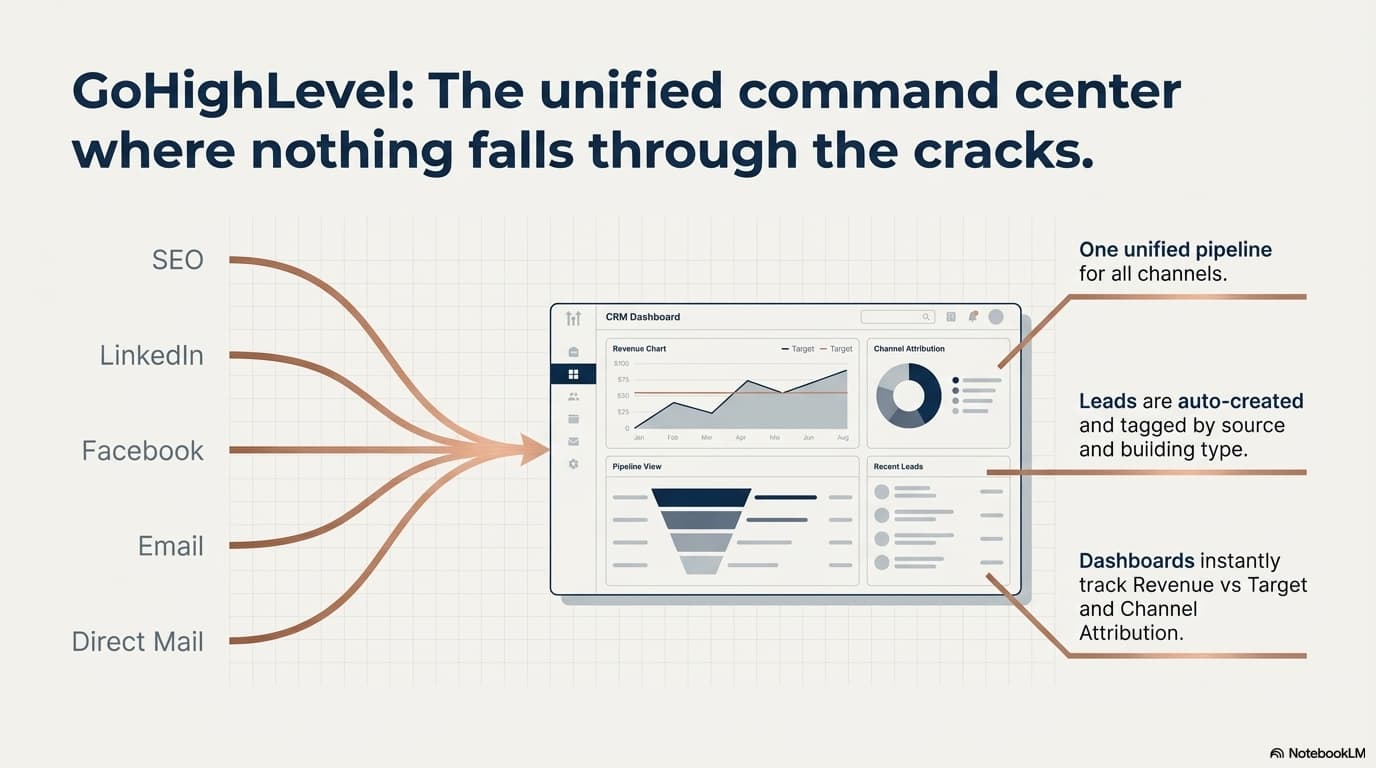
New Contact: Auto-created from any source — web form, LinkedIn reply, Facebook DM, email response, or QR scan. Tagged by source channel and building type.
Qualified: Decision-maker confirmed, building type and rough scope understood. Meeting or inspection being scheduled.
Inspection Scheduled: Site visit booked. Automated reminder sequences fire 48 hours and 2 hours before. Aerial measurement report attached to the record if applicable.
Proposal Out: Scope and estimate sent. An automated follow-up sequence engages the contact every 2–3 days until a response is received.
Negotiation: Active discussion on scope, price, or timeline. Automated task reminders ensure no deal goes dark for more than 3 business days.
Won / Lost: Job awarded or lost. Won jobs move to production pipeline. Lost jobs enter a 90-day re-engagement sequence to stay visible for the next opportunity.
Commercial roofing decisions move slowly — sometimes 60 to 180 days from first contact to signed contract. The automation layer is what ensures opportunities don't go cold during that window because someone forgot to follow up.
For contractors also running Google Local Services Ads alongside their organic SEO and outbound stack, see: How to Generate Roofing Leads Through Google LSA — The 2025 Playbook. It covers how to route LSA leads directly into your GoHighLevel pipeline for unified tracking and follow-up.
BAADIGI builds and delivers a complete GoHighLevel environment — not a template, a configured system. Custom pipeline stages, custom fields for building type and roof system, tag logic by channel and urgency, automation workflows, calendar integrations, and reporting dashboards. Training and written SOPs are included so your team operates in the system confidently from day one.
Everything described in this article — the SEO structure, the AI prospecting agents, the LinkedIn and social listening workflows, the email and mailer campaigns, and the GoHighLevel command center — is the commercial-focused half of the full acquisition system. For the complete picture including residential and all lead generation channels, read The Complete 2026 Guide to Generating Exclusive, High-Quality Commercial and Residential Roofing Jobs.
BAADIGI COMMERCIAL ROOFING AI STACK — COMPLETE COMPONENTS
Commercial-focused website and SEO structure targeting 'Big Game,' 'Local Money,' and 'Specialist' keyword buckets
Google Business Profile optimization for Map Pack dominance in your service territory
AI LinkedIn prospecting agent: ICP filters, prospect scoring, personalized outreach sequences, CRM integration
Social listening agent: keyword monitoring across targeted Facebook groups and community forums
Dream 100 target list: built, cleaned, and enriched with decision-maker contact data
AI-personalized email campaign sequences: 30–60 day multi-touch campaigns by ICP segment
Physical mailer campaigns: AI-drafted, property-specific letters with QR tracking
GoHighLevel CRM build: commercial pipeline, custom fields, tags, automations, dashboards, and SOPs
Training, documentation, and 30-day post-launch monitoring and optimization
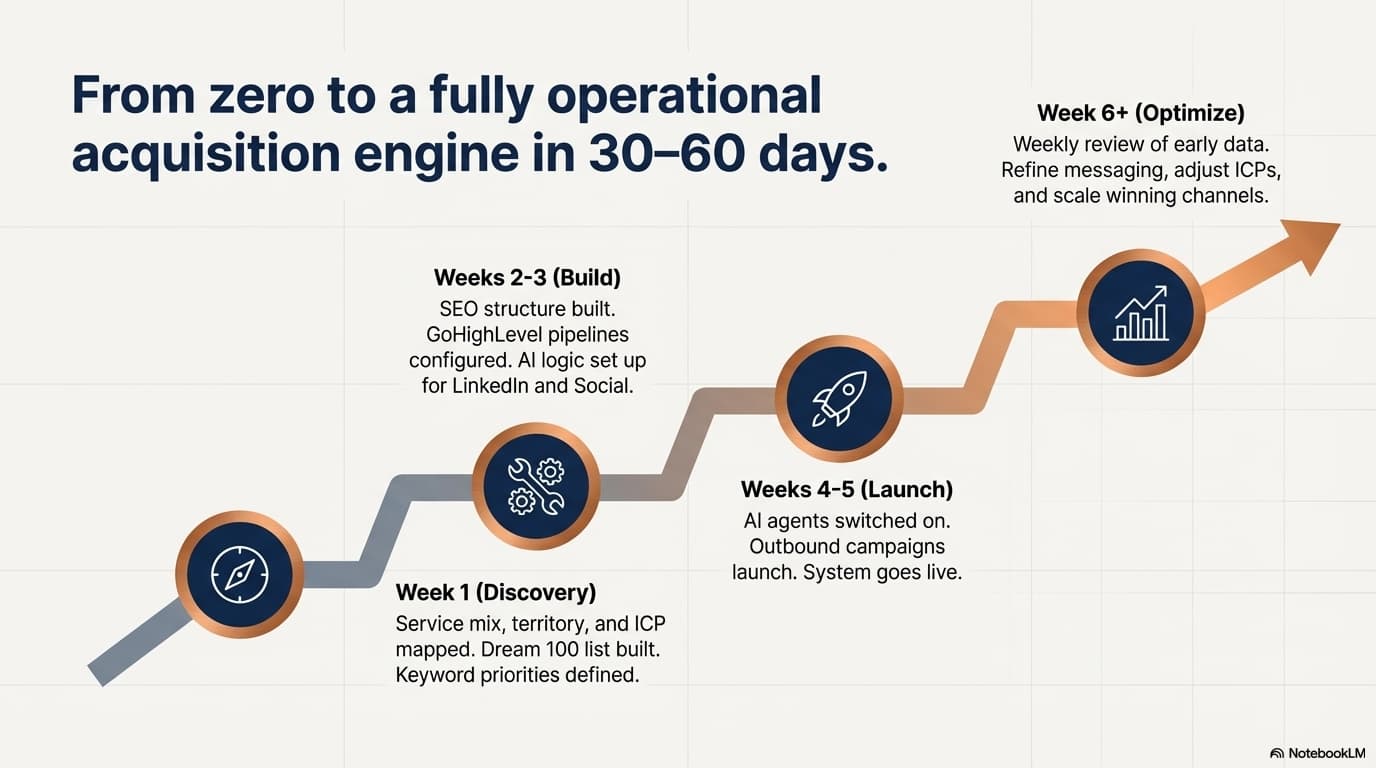
Week 1 — Discovery and Mapping: Audit of current tools, CRM, website, and market position. Service mix, territory, and ICP mapped. Keyword priorities defined. Initial Dream 100 list built.
Weeks 2–3 — Build Phase: SEO structure and core commercial pages built. GoHighLevel pipelines, custom fields, and automations configured. AI agent logic set up for LinkedIn and social listening.
Weeks 4–5 — Launch Phase: AI prospecting agents switched on. Email and mailer campaigns launched. GBP optimization completed. Full system live and monitored.
Week 6+ — Optimize and Scale: Weekly review of early results. ICP adjustments, messaging refinements, and channel prioritization based on data. Scale investment toward winning channels.
You're not buying ideas, a checklist, or a strategy deck. You're getting an installed, configured, and operational system — designed from the first consultation around your specific market, your services, and your revenue target. BAADIGI treats your business like a systems engineering problem, not a marketing project.
Every component is documented. Every workflow is tested. Every integration is live before we call the implementation complete. And ongoing optimization means the system gets better over time, not worse.
Before committing to any lead generation investment, it's worth benchmarking your options: Roofing Leads Guide 2026 — Every Channel, Ranked by ROI and Difficulty. It gives you the framework to evaluate what BAADIGI builds against every alternative available to commercial contractors this year.
The commercial roofer who wins in 2026 is not the one with the biggest sales team. It's the one with the best AI-driven acquisition system — one that runs daily, captures opportunities competitors miss, and keeps every open deal alive through a long commercial sales cycle.
Building that system yourself is possible. It takes 12–18 months, significant trial and error, and a level of technical integration work that most roofing operators don't have bandwidth for. BAADIGI installs it in 30–60 days — a configured, operational system built specifically for commercial roofing acquisition in 2026.
The starting point is our complete commercial and residential lead generation ecosystem guide: The Complete 2026 Guide to Generating Exclusive, High-Quality Commercial and Residential Roofing Jobs. Read it, then let's map your market together.
And if you're still weighing purchased leads as part of the mix, here's the honest comparison: 3 Affordable Roofing Lead Providers With Pay-Per-Lead Pricing — and One Better Alternative.
Book Your Commercial AI Roofing Blueprint Call
We'll map exactly how this stack looks in your market — which keyword buckets to prioritize, how to configure your ICP for LinkedIn and outbound, and what a realistic path to $400,000/month in commercial projects looks like for your company.