3 Best Roofing Lead Providers Compared (2026 Pricing & ROI)

The real cost of a shared roofing lead isn't $35–$200. It's the $8,000 job you lost because three other contractors got the same phone number. We compared Google LSA, Angi, and Thumbtack head-to-head — real pricing, real close rates, real cost per booked job — so you can see where your money actually goes.
Below is the side-by-side comparison. Scroll to the bottom for the exclusive-territory alternative that eliminates the bidding war entirely.
IN THIS GUIDE:
| Provider | Cost Per Lead | Lead Type | Avg Close Rate | Cost Per Job |
|---|---|---|---|---|
| Google LSA | $45–150 | Exclusive (verified call) | 15–25% | $300–600 |
| Angi (HomeAdvisor) | $30–80 | Shared (3–5 contractors) | 5–10% | $500–800 |
| Thumbtack / CraftJack | $20–60 | Shared (bid-based) | 3–8% | $600–1,000 |
| BaaDigi (Exclusive Territory) | $0/lead (owned asset) | Exclusive (yours only) | 25–35% | $200–400 |
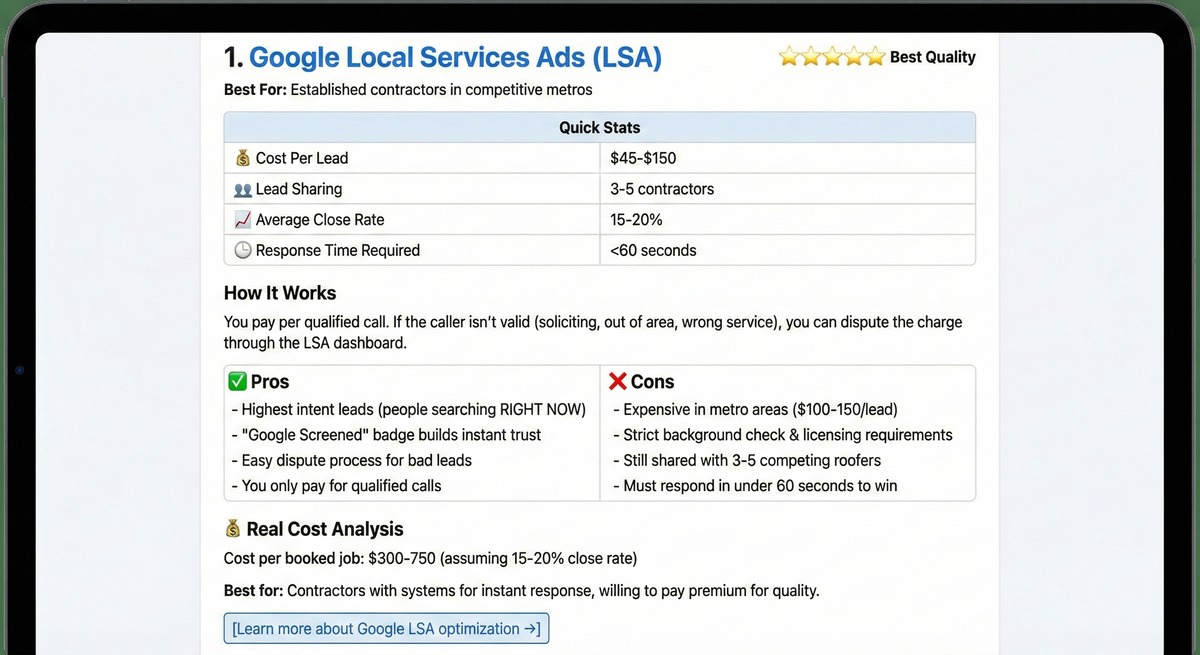
🟢 Google Local Services Ads (LSA) $45–150/lead | Highest Intent The gold standard for immediate visibility, but costs are rising.
🟠 Angi (HomeAdvisor) $30–80/lead | Massive Volume The 800lb gorilla. High volume, but you share the lead with 3 others.
🔴 Thumbtack / CraftJack $20–60/lead | Budget Option Lower cost, but often attracts price-shopping homeowners.
🔵 The Exclusive Territory Model $0/lead (Owned Asset) | Market Control Why building your own engine beats renting from the lead brokers above.
About Pay-Per-Lead Roofing
What is the best way to find affordable roofing leads?
To find affordable roofing leads, look for pay-per-lead (PPL) providers like Google Local Services Ads, Thumbtack, or industry-specific agencies like Baadigi. The most "affordable" leads are not necessarily the cheapest upfront, but the ones with the highest close rate—typically found through exclusive territory agreements rather than shared marketplaces.
How does pay-per-lead roofing pricing work?
Pay-per-lead (PPL) pricing charges you a fixed fee for every valid inquiry (call, form fill, or message) you receive, ranging from $35 to $150+ depending on the market and job type. Unlike monthly retainers, you only pay for the opportunity to bid, though many PPL networks share these leads with 3–5 other roofers.
Why are cheap roofing leads often not profitable?
Cheap roofing leads (under $40) are often "aged" (old data), shared with dozens of contractors, or generated by low-intent "tire-kickers." While the upfront cost is low, the cost-per-acquisition (CPA) skyrockets because you have to buy hundreds of them to close a single job.
The Landscape of Pay-Per-Lead Roofing: Who’s Who?
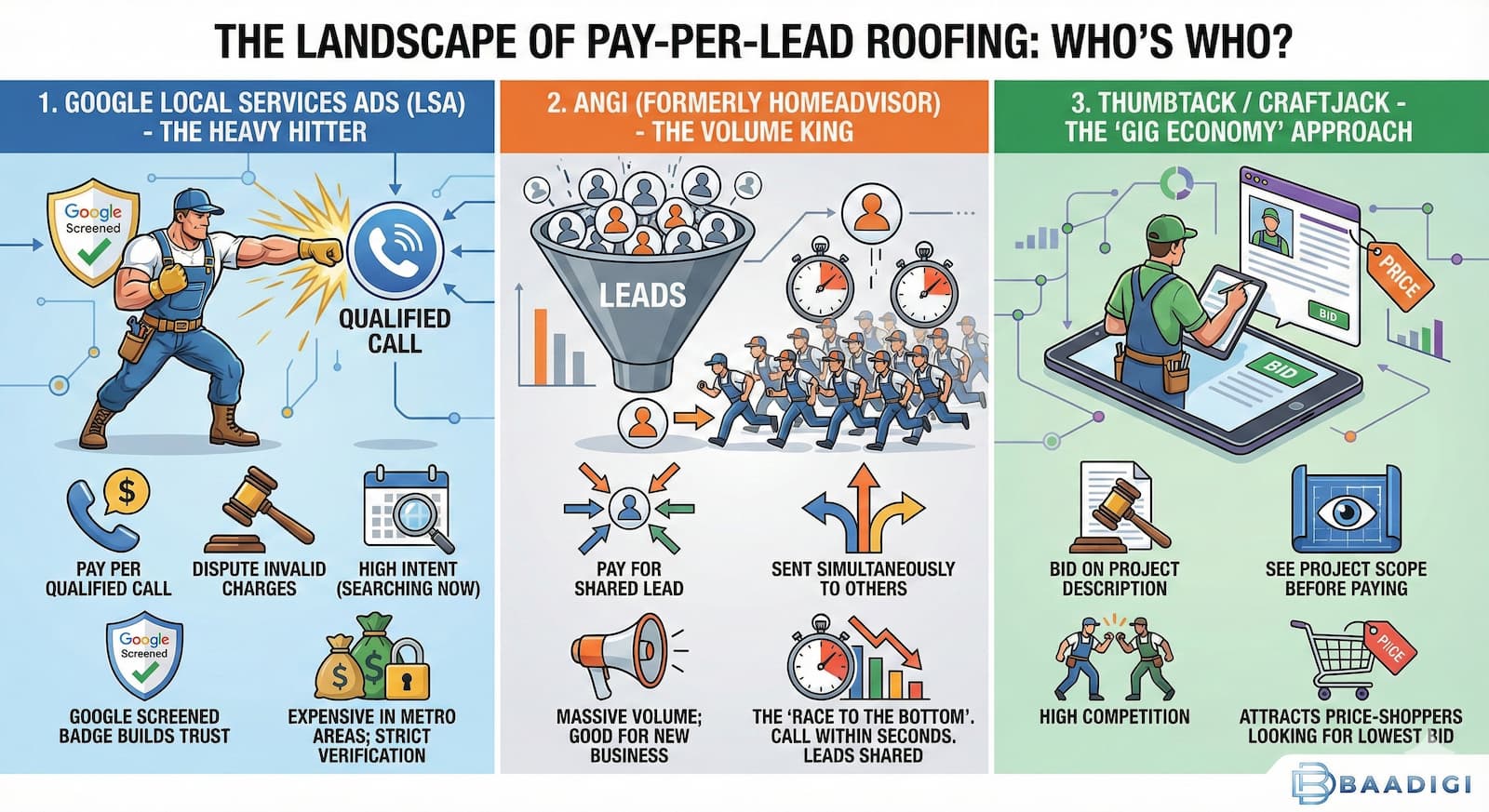
If you’re looking to fill your pipeline without a massive upfront retainer, Pay-Per-Lead (PPL) is the standard entry point. However, not all PPL providers are created equal. As a Google Premier Partner managing thousands of campaigns, we’ve analyzed the data. Here is the breakdown of the major national players.
"Get Free Market Analysis (See What You're Losing)"
1. Google Local Services Ads (LSA)
The Verdict: The heavy hitter. How it Works: You pay per qualified call. If the caller isn't valid (e.g., soliciting services or out of area), you can dispute the charge. Pros: High intent (these people are searching now), "Google Screened" badge builds trust. Cons: Can be expensive in metro areas; strict verification process.
2. Angi (formerly HomeAdvisor)
The Verdict: The volume king. How it Works: You pay for a lead that is simultaneously sent to other contractors. Pros: Massive volume; good for new businesses needing any at-bats. Cons: The "Race to the Bottom." You must call within seconds. Leads are shared, meaning you often pay for a lead you never even speak to.
3. Thumbtack / CraftJack
The Verdict: The "Gig Economy" approach. How it Works: Similar to Angi, but often relies on you "bidding" on a project description before getting the contact info. Pros: You can see the project scope before paying. Cons: High competition; often attracts price-shoppers looking for the lowest bid.
The "Affordability" Trap: Why Cheap Leads Cost More
In the Marines, there’s a saying: "Slow is smooth, smooth is fast." In roofing sales, "Cheap is expensive."
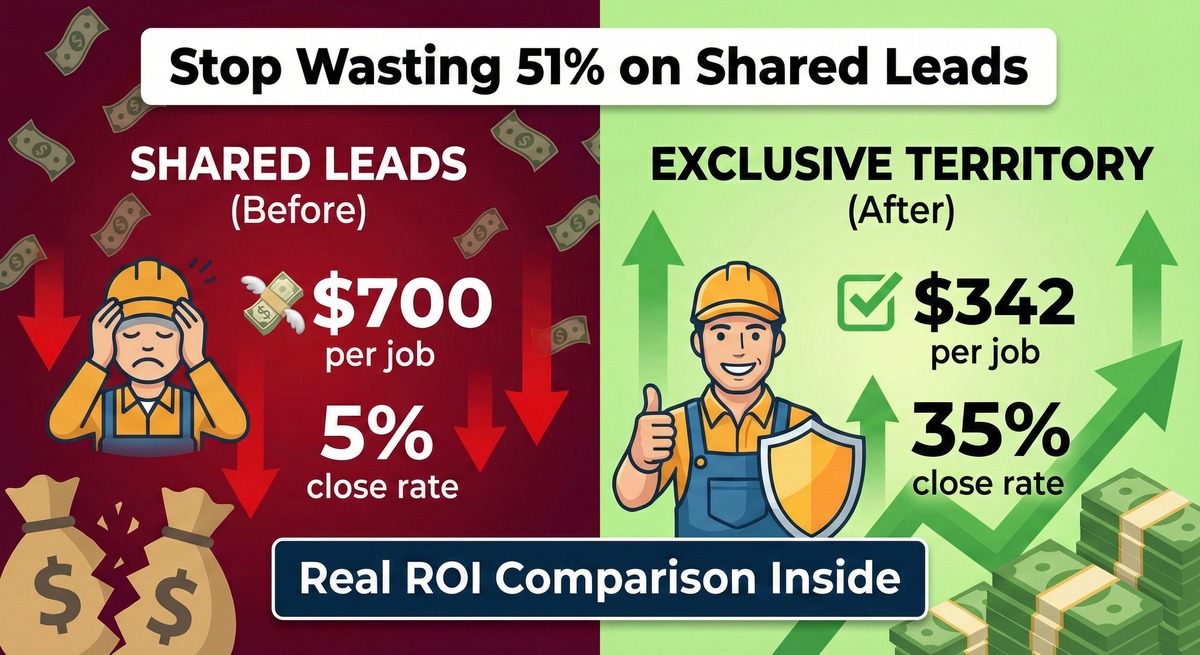
Many roofers fixate on the Cost Per Lead (CPL). They want $25 leads. But if you have to buy 20 of them ($500) to close one small repair job because the lead quality is trash, your math is broken.
The Profitable Equation:
- Shared Lead: $35 cost. Shared with 4 roofers. Close rate 5%. Cost per Job: $700.
- Exclusive Lead (Baadigi): $120 cost. Yours alone. Close rate 35%. Cost per Job: $342.
The Hack: Stop asking "How much is the lead?" Start asking "What is the cost per booked roof?"
The Baadigi Difference: Exclusive Territory vs. Shared Chaos
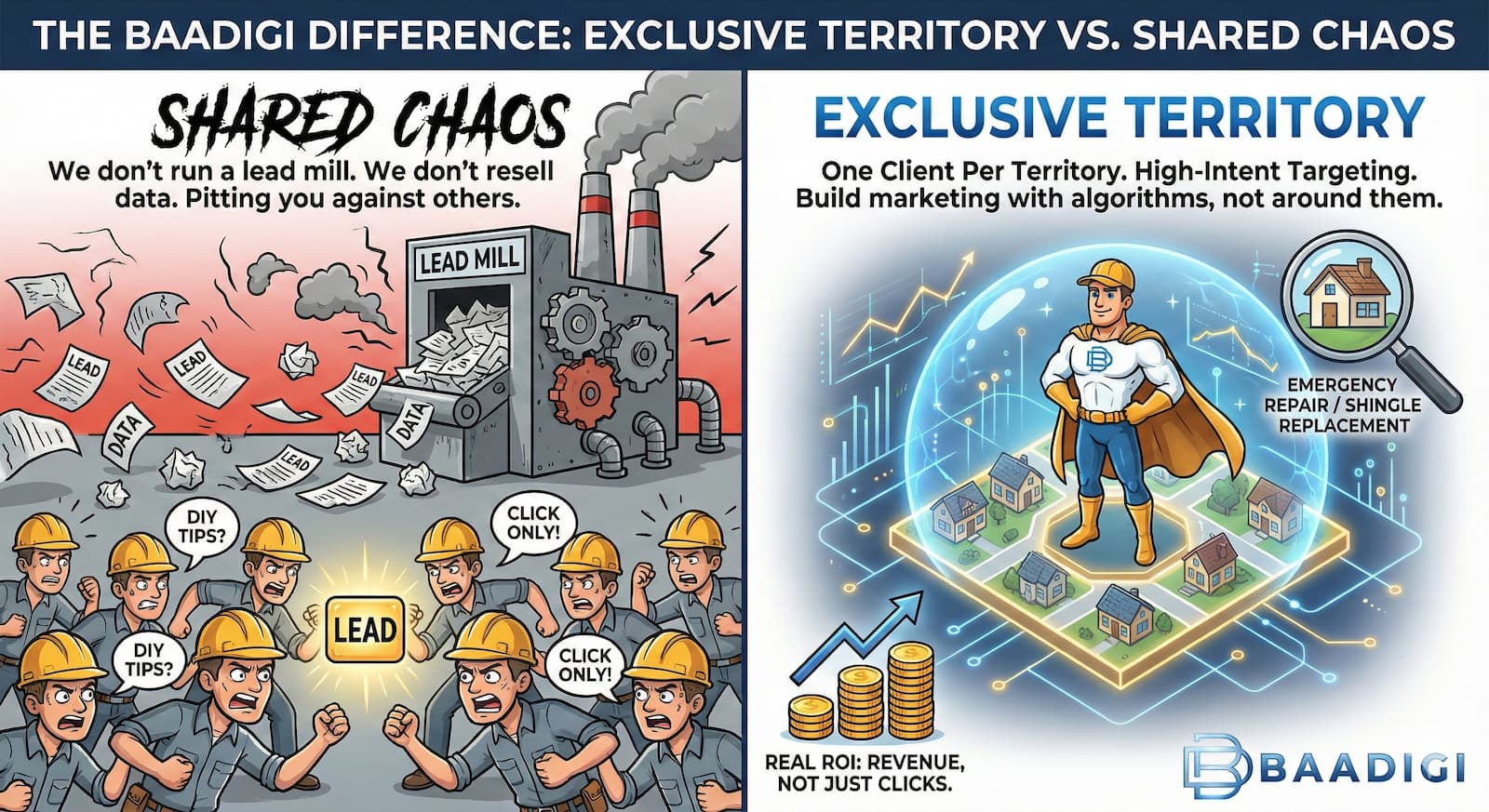
We don’t run a lead mill. We don’t resell data. At Baadigi, we build marketing with algorithms, not around them.
While we manage pay-per-lead structures via Google LSAs for our clients, our core philosophy is Territory Domination.
- One Client Per Territory: We don't pit you against other roofers.
- High-Intent Targeting: We target homeowners searching for "emergency roof repair" or "shingle replacement," not people looking for "DIY roof tips."
- Real ROI: We track revenue, not just clicks.
Case Study: The "Cheaper" Mistake A roofing company in Ohio came to us after spending $3,000 on "discount leads" from a generic data broker. They closed zero jobs. We shifted them to an exclusive territory model. Lead volume dropped by 40%, but lead quality skyrocketed. They booked $80k in revenue the first month.
Don't buy leads. Buy market share.
Ready to Stop Paying for "Shared Chaos"? You’ve seen the math: cheap leads are expensive, and shared leads are a race to the bottom. It’s time to upgrade your pipeline with high-intent, exclusive homeowners who are ready to hire.
Get Your Free Market Analysis:
📞 (714) 707-2483
FAQs Answered By Pros
What is a fair price for a roofing lead in 2025?
For a shared lead, expect to pay $35–$75. For an exclusive, high-intent roofing lead (storm damage or replacement), fair market value is typically $90–$200 depending on your location. Remember: exclusivity justifies the higher price tag.
How do I dispute bad leads with pay-per-lead providers?
Most major providers (like Google LSA or Angi) have a dispute dashboard. You must listen to the call recording and flag it (e.g., wrong number, wrong service, solicitor). Pro Tip: Baadigi handles these disputes for our clients to ensure you aren't paying for junk. For step-by-step LSA setup instructions, see our complete Google LSA optimization guide.
Can I grow a roofing business solely on pay-per-lead platforms?
It is difficult to scale profitably on shared PPL alone due to the diminishing returns and high competition. A healthy marketing stack should include organic SEO and exclusive territory campaigns to lower your average cost of acquisition over time.
Are "pay-at-closing" lead services legitimate?
Some exist, often taking a 10–20% cut of the job. While low risk, they are rare and often restrictive. Most "pay-at-close" offers are lead generation agencies that require you to use their sales software and pricing models, reducing your control.
What is the biggest red flag when buying affordable roofing leads?
Avoid providers who refuse to define "exclusive" in writing or who sell "aged" leads (data older than 24 hours). If they can't verify the origin of the lead (e.g., a specific landing page or ad), it’s likely recycled data.
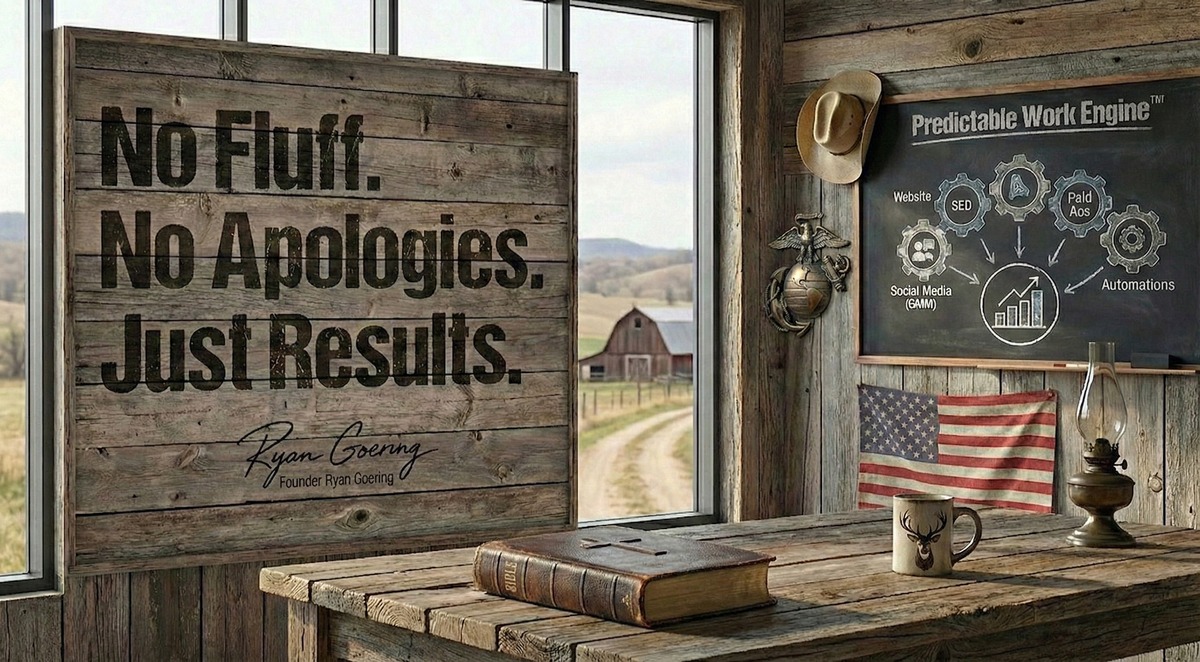
No Fluff. No Apologies. Just Results.
A Note from Founder Ryan Goering
I’ve built my life and this business on a simple foundation: God, Family, Country, and the work we do.
I believe that real success comes from resilience—showing up every day, learning from the hard times, and staying committed to the win. I value old-school integrity over corporate polish, which means I’ll always be straight with you. We build partnerships based on trust, transparency, and a shared drive to build something that lasts.
The Hard Truth Here is what I’ve learned after working with 2,000+ of you: Most contractors treat marketing as an expense, not an investment.
You’ve been burned by agencies selling you "parts"—a Facebook ad here, some SEO there, maybe a shiny new website. That is "piecemeal" marketing. It’s like trying to build a truck with parts from five different manufacturers and wondering why it won't start.
The Solution: Predictable Work Engine™ That is why I stopped selling "services" and started installing Systems.
We don't ask if you "want" SEO or Social Media. We install the whole engine. My team builds your entire infrastructure—Website, SEO, Paid Ads, Social Media (SMM), and Automations—so they work together.
We Tune the Machine to Your Market. Every territory is different. In some cities, we might throttle the Ads to 60% and SEO to 20%. In others, we lean harder on Social Media. We tune the dials based on what your business needs to dominate your map.
The Goal? Fire the Lead Brokers. The entire point of this system is to get you off the "shared lead" drug (Angi, Thumbtack, HomeAdvisor). We build assets you own so you never have to compete for a lead again.
Sources & Further Reading
Keep Reading:
- Roofing Lead Generation: The Complete 2026 Guide
- SEO for Contractors — How we rank roofers #1 in their service area
- PPC Advertising for Contractors — Google Ads + LSA management
- The Predictable Work Engine™ — Our complete lead-to-job system
Free website audit — see what's costing you leads
No email required. Takes 2 minutes. Completely free.

Ryan Goering
CEO & Founder, BaaDigi
U.S. military veteran and digital marketing strategist who built BaaDigi to help contractors generate predictable leads and revenue. 15+ years in SEO, PPC, and AI-powered marketing automation.
Frequently Asked Questions
What is the cheapest way to get roofing leads?▼
The cheapest long-term source is SEO and Google Business Profile—once established, organic leads cost $5–$15 each with no ongoing per-click expense. Getting there takes 6–12 months of consistent optimization, so for immediate leads, Google Local Service Ads are the most cost-efficient paid option at $25–$50 per exclusive lead (you only pay for real calls, not wasted clicks). By contrast, shared lead services like HomeAdvisor and Angi charge $30–$100+ per lead but send that same lead to 3–5 competing contractors, making your effective cost per booked job $250–$750+. The cheapest sustainable approach is a combination: LSAs for immediate exclusive leads while SEO builds in the background, then shift budget toward organic as it matures.
Are shared roofing leads worth it?▼
Shared leads can work as a short-term cash flow tool for new contractors, but the economics are poor as a long-term strategy. Shared leads from Angi, HomeAdvisor, or Thumbtack cost $20–$60 each but are simultaneously sent to 3–5 competing contractors, dropping close rates to 5–15%. Even at a generous 15% close rate, you're paying $133–$400 per booked job before any overhead. Exclusive leads—from your own Google Ads, LSAs, or SEO—close at 30–50% because the homeowner specifically chose to contact you. That same $30–$60 per lead at a 40% close rate costs $75–$150 per booked job. The compounding problem: every dollar spent on shared platforms funds the platform's brand equity, not yours. Stop paying and the leads stop immediately; there's nothing left to show for the investment.
How many leads does a roofing company need per month?▼
Lead volume requirements depend on your average job value, close rate, and revenue goals. At a 20% close rate and $10,000 average job, you need 5 leads to book one job worth $10,000. To generate $1M in revenue, you need 100 booked jobs, which requires 500 leads at that close rate. At a 40% close rate (exclusive leads), you only need 250 leads for the same revenue. Practically speaking: a roofing company doing $1M–$2M in revenue typically needs 50–120 leads per month across all channels. Companies scaling to $3M+ need 100–200+ leads monthly. The most efficient path to more revenue is improving close rate before increasing lead volume—a 5% close rate improvement on 100 monthly leads saves more money than generating 20 extra leads.
What is the best roofing lead generation company?▼
No third-party lead company is the best long-term answer—building your own lead generation system always wins on cost per booked job after 12–18 months. That said, for immediate lead flow, Google Local Service Ads (run by Google directly) are the highest-quality paid lead source because the Google Guaranteed badge builds homeowner trust and you only pay for real calls. For third-party services, CraftJack tends to be cheaper than HomeAdvisor ($10–$50 vs $15–$100 per shared lead) and sends leads to fewer contractors. The honest best answer: invest in Google Ads, optimize your GBP, and build your SEO simultaneously. Within 12 months, your owned channels will outperform any third-party service on both lead quality and cost per booked job.
How do I improve my close rate on roofing leads?▼
The single biggest lever is speed-to-lead. Research consistently shows that contractors who respond within 5 minutes close at 2–3x the rate of those who respond in 30–60 minutes. Set up automated SMS response so every new lead gets a text within 60 seconds, even if you're on a job. Beyond speed: have a consistent follow-up cadence (call, text, call over 3 days if no response), present a detailed written estimate with photos and a clear scope of work, collect and showcase Google reviews prominently, and offer financing options for replacement jobs. Track close rate by lead source—exclusive leads from your own marketing consistently close at 30–50%, while shared leads average 10–20%. Focusing budget on channels with higher close rates automatically improves overall ROI without changing your sales process.
What is the ROI on roofing marketing?▼
Well-managed roofing marketing should return $5–$15 for every $1 invested when measured over a 12-month period. In the early months (1–6), expect a 3:1 return as campaigns optimize and SEO builds. By month 12+, contractors with established organic presence and optimized PPC campaigns typically see 8–15x returns on their total marketing investment because SEO-generated leads cost $5–$15 each at no incremental spend. The National Association of Home Builders data shows that contractors who consistently invest 8–10% of revenue in marketing grow 2–3x faster than those who invest under 5%. If your marketing ROI is below 3:1, fix the funnel (response time, close rate, website conversion) before increasing ad spend—more traffic into a leaky funnel just costs more money.
Popular Contractor Marketing Guides
Explore More Topics
Ready to Get More Leads?
Get a free marketing audit for your contracting business. We'll show you exactly where you're losing leads.
Get Your Free AuditRelated Articles
Local Service Ads (LSAs) for Remodeling Leads: Setup, Optimization, and Lead Handling
Google Local Service Ads put remodelers at the very top of search results with a Google Guarantee badge. Here's how to set them up and win.
How Much Do Contractor Leads Cost? "By Trade"
Contractor lead costs vary dramatically by trade, from $20 for basic plumbing leads to $300+ for roofing. Understanding these costs and how to calculate your maximum affordable cost per lead is crucial for profitable marketing campaigns.
Home Addition & Whole-Home Remodeling Leads: Landing the Big-Ticket Jobs
Big-ticket remodeling jobs don't come from the same playbook as kitchen and bath leads. Here's how to attract $50k-$500k+ home addition projects.