





Support center (714) 707-2483

Writen by Ryan R Goering

Contractor marketing fails when it relies on disconnected tactics instead of a single, integrated system that turns traffic into booked jobs. A tactic-first approach leads to wasted ad spend, poor follow-up, and missed opportunities to build long-term equity in your own marketing infrastructure.
Most contractor marketing is tactic-driven: a new SEO package here, a few Facebook ads there, maybe a website redesign when things slow down. Without a unified strategy, these efforts behave like isolated “dart throws” that rarely compound over time.
The real issue is that tactics do not talk to each other. Your ads send clicks to a website that does not convert, your CRM is not connected to your forms, and no one consistently follows up on leads. The result is a leaky system where money goes out faster than booked jobs come in.
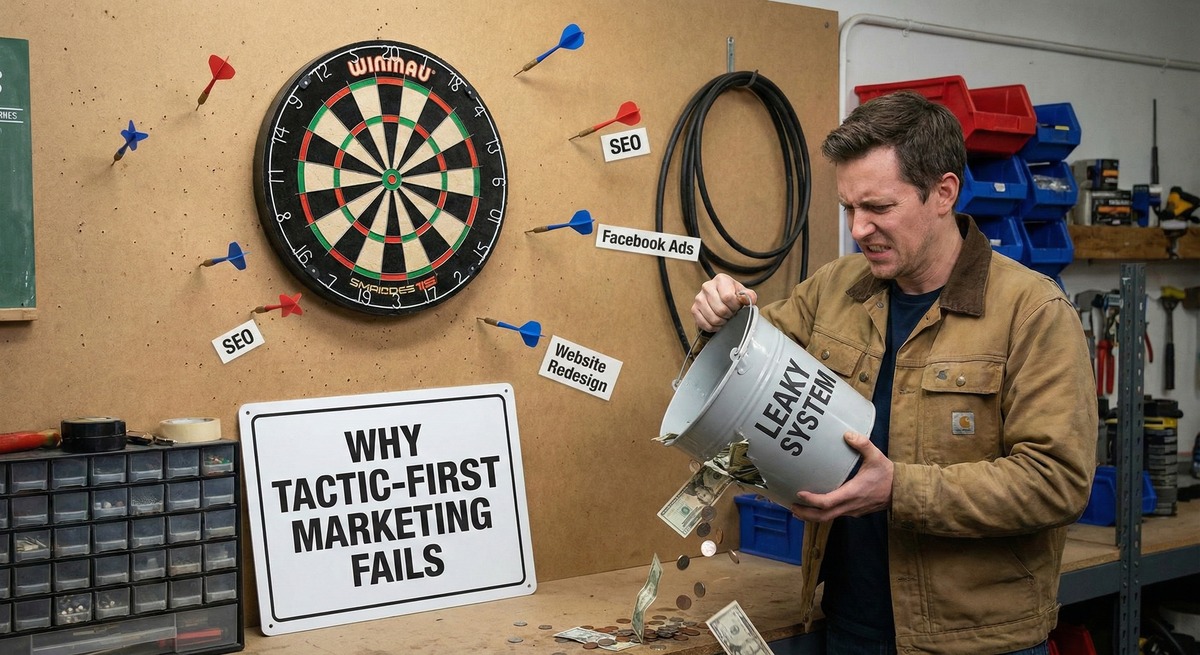
A system-first approach flips the order: instead of asking “Which tactic should I buy?”, you ask “What kind of machine do I need to consistently book jobs?”.
Core building blocks of a contractor marketing system:
A beautiful site that does not convert is just a digital brochure. Design alone does not create booked jobs.
To make your website a true sales asset:
Without these elements, even expensive websites behave like pretty boats with no engine or rudder.
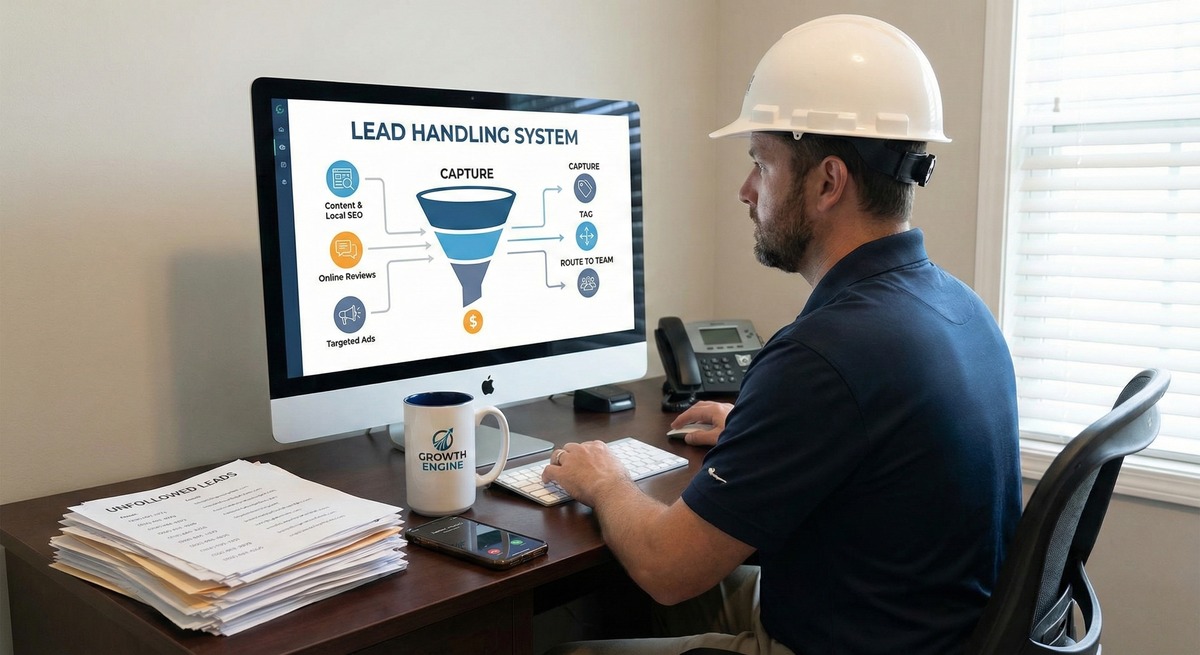
Leads alone do not grow a contractor business; lead handling systems do. Many contractors think they have a lead problem when they really have a follow-up and conversion problem.
Effective lead generation channels for contractors:
Every one of these must connect into a centralized system that captures, tags, and routes leads to your team for follow-up.
Speed-to-lead has become a non-negotiable element of contractor marketing. Multiple studies show that leads contacted in the first five minutes are dramatically more likely to convert than those contacted later.
Practical instant follow-up strategies:
Responding quickly signals reliability and professionalism before a tech ever arrives at the job.
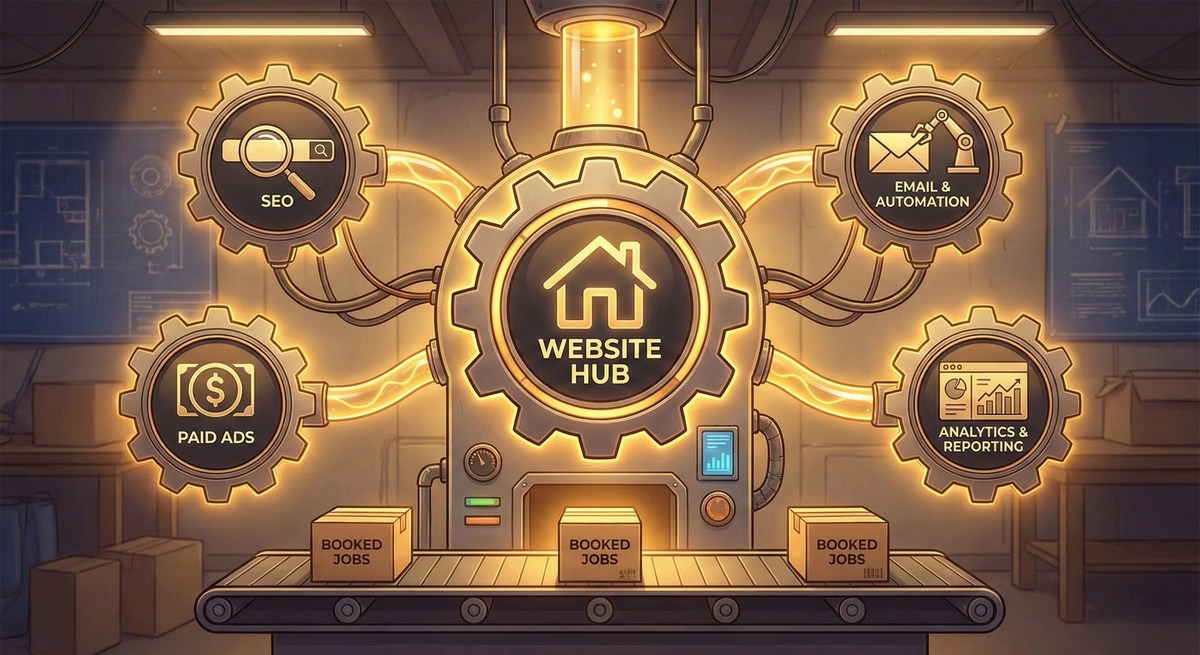
A complete contractor marketing engine is what happens when all of your tools and tactics are wired together and measured against booked jobs, not vanity metrics.
Key components of an effective engine:
When these parts are integrated, your marketing behaves like an engine—turn it on, add fuel (traffic), and it consistently produces work.
Tracking is not the same as optimizing. Many contractors install basic tracking, glance at traffic numbers, and then make big decisions with little context.
Metrics worth watching and interpreting:
Data only becomes useful when it shapes decisions—budget shifts, landing page changes, new offers, and better follow-up processes.
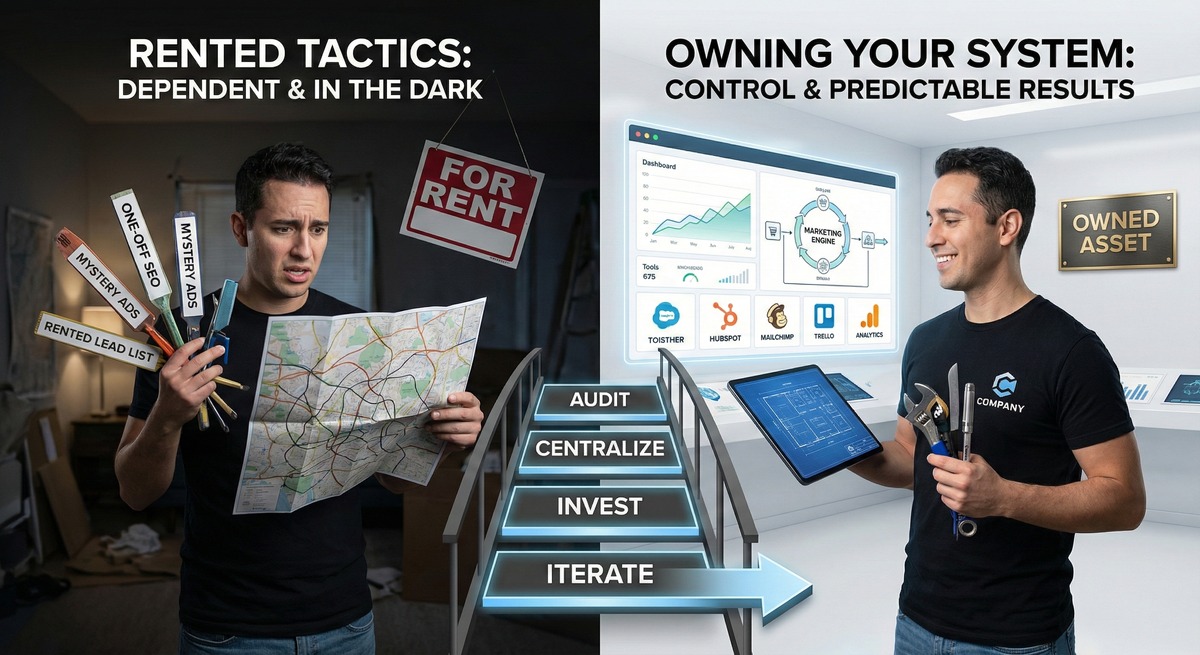
Rented tactics (like one-off SEO packages or “mystery” ad services) keep you dependent and in the dark. Owning a system means you control your assets and understand how they work together.
Steps to owning your marketing:
Owning your system gives you leverage: campaigns are easier to scale, problems are easier to diagnose, and results are more predictable.
Contractor marketing is the set of strategies and tools used by trades—such as plumbing, electrical, HVAC, remodeling, and more—to attract, convert, and retain customers within a local or regional market.
Because they rely on isolated tactics instead of a cohesive system. Random ads, a website, and “some SEO” don’t work unless they’re connected. Without a system that tracks, nurtures, and converts leads into booked jobs, marketing becomes guesswork.
Visibility, conversion, qualification, booking, and ongoing optimization—each piece connected into one integrated engine. When everything works together, revenue becomes predictable instead of stressful.
Add clear calls to action, simple forms, and a mobile-first design. Layer in tracking tools so you can test, measure, and improve over time. A website that doesn’t convert is just a very expensive business card.
Because speed closes jobs. Leads contacted within minutes are far more likely to convert. Every delay increases the odds that a competitor gets there first.
Focus on revenue-driving metrics: lead conversion rate, cost per lead, cost per booked job, and customer lifetime value. If it doesn’t tie back to dollars, it’s a distraction.
Own your website, your tracking, your automations, and your data. Agencies and vendors should support your system—not replace it. Ownership equals control.
Because homeowners actively search for services on Google. Strong SEO boosts visibility in organic results and local map listings—still two of the highest-intent channels in home services.
Packages are collections of tasks. Systems are integrated, measurable processes built around outcomes like booked jobs and revenue. One keeps you busy; the other builds a business.
Yes—especially with the right tools and processes. Most contractors see the best results when they own the system internally and use specialized external partners to scale faster.
Use these tools as building blocks in your system:
Use anchor text and link these to relevant posts on your site:
Most contractor marketing fails because it is built on scattered tactics rather than a unified system that tracks, nurtures, and converts leads into booked jobs. When you replace “shiny-object” tactics with an integrated marketing infrastructure—visibility, conversion, qualification, booking, and optimization—you build a durable, scalable engine for growth.
Ready to stop the cycle of ineffective marketing and start building a system that consistently books jobs? At BaaDigi, the focus is on creating tailored digital infrastructures specifically for contractors, from local SEO foundations to integrated lead follow-up workflows. Contact the team today to see how your marketing can be transformed into a predictable growth machine.

A Note from Founder Ryan Goering
I run my life and my business on four things: God, Family, Country, and Marketing.
I’ve failed before, and I’ll probably fail again. But I will always outwork the guy next to me to find the win. I’m not here to talk politics, and I’m not here to tiptoe around your feelings. If my bluntness offends you, you don’t have to keep reading—and we probably shouldn't do business together. I say what I mean, and I do what I say.
The Track Record I’ve been doing SEO since 2008 and running this agency since 2015. I’ve serviced over 2,000 contractors across every trade imaginable. I’ve seen thousands of campaigns succeed, and I’ve seen just as many fail.
The Hard Truth Here is what I’ve learned after working with 2,000+ of you: Most contractors treat marketing as an expense, not an investment.
You’ve been burned by agencies selling you "parts"—a Facebook ad here, some SEO there, maybe a shiny new website. That is "piecemeal" marketing. It’s like trying to build a truck with parts from five different manufacturers and wondering why it won't start.
The Solution: Predictable Work Engine™ That is why I stopped selling "services" and started installing Systems.
We don't ask if you "want" SEO or Social Media. We install the whole engine. My team builds your entire infrastructure—Website, SEO, Paid Ads, Social Media (SMM), and Automations—so they work together.
We Tune the Machine to Your Market. Every territory is different. In some cities, we might throttle the Ads to 60% and SEO to 20%. In others, we lean harder on Social Media. We tune the dials based on what your business needs to dominate your map.
The Goal? Fire the Lead Brokers. The entire point of this system is to get you off the "shared lead" drug (Angi, Thumbtack, HomeAdvisor). We build assets you own so you never have to compete for a lead again.