


Support center (714) 707-2483

Writen by Ryan R Goering
Q: Is it actually realistic to grow a contracting business from $1M to $3M in 18 months?
Yes — but only for contractors who treat the business as a system, not a job site. The $1M to $3M leap is one of the most documented growth patterns in the trades, and it consistently happens in 12-24 months when three conditions are met: the owner stops working in the business and starts working on it, lead generation becomes predictable rather than referral-dependent, and operations are systematized enough to handle volume without the owner as the bottleneck. Contractors who attempt to scale by simply taking on more work — without changing how the business operates — almost always plateau or break down before reaching $3M.
Q: What's the biggest thing holding $1M contractors back from reaching $3M?
Owner dependency. At $1M, the contractor is usually the best estimator, the quality control, the sales closer, and occasionally still on the tools. That model has a hard ceiling — it caps at whatever one person can personally oversee. The contractors who break through are the ones who build systems and people that perform without them. This isn't a motivation problem. It's a structural one. The business needs to be rebuilt around processes, not personalities.
Q: How much does it cost to scale a contracting business to $3M?
Realistically, $150,000 to $200,000 in total investment over 18 months, deployed across digital marketing ($30-50K), technology and software ($20-30K), key hires ($60-80K), training ($10-15K), and working capital ($30-40K). At 10% net margins on an additional $1M in year one revenue, you break even on investment in year one. By year two at $3M and improved margins of 12%, you're generating $360,000 net profit — a 180% return on the initial investment.
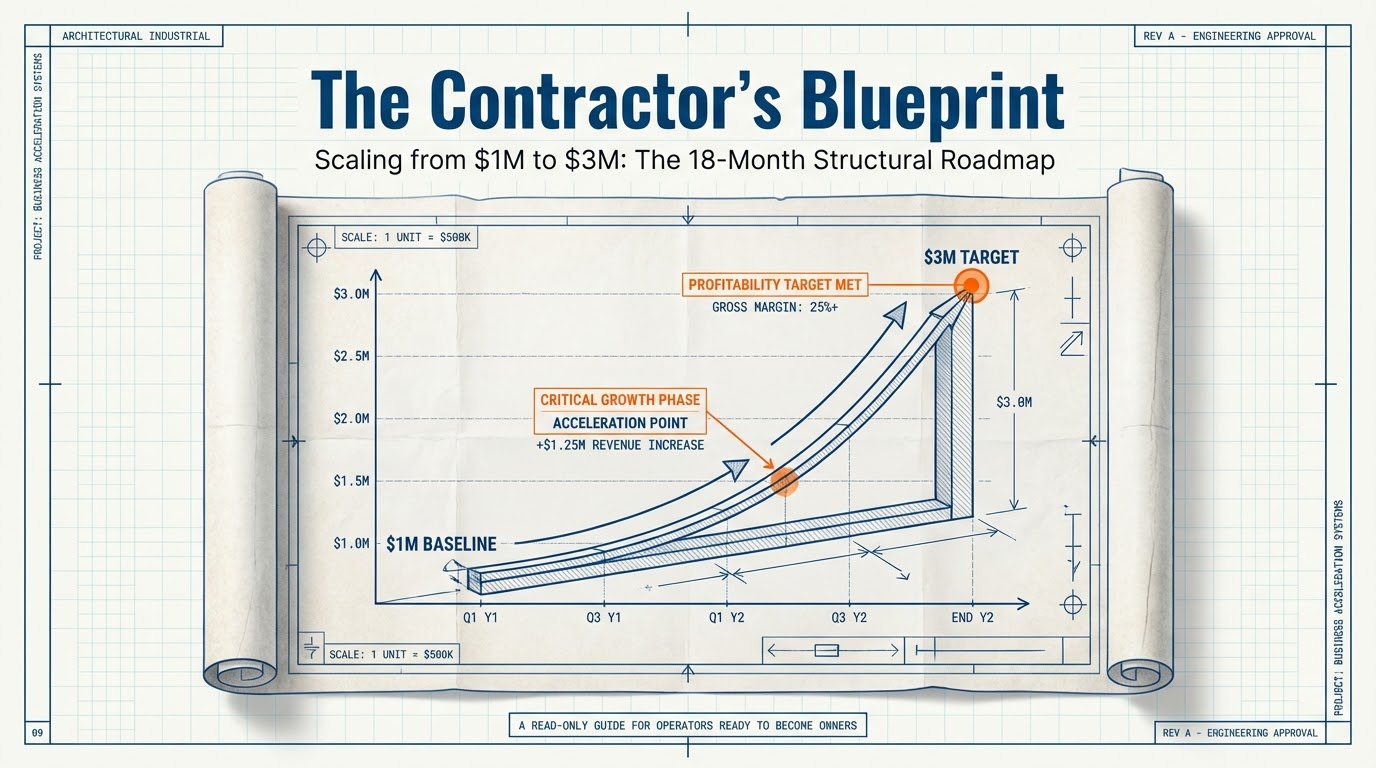
Only 9% of small businesses ever reach $1 million in revenue. The percentage that reaches $3 million is smaller still. This isn't because the other 91% lack skill or work ethic — most contractors at the $700K-$1M level are exceptional at their craft. The barrier is almost never technical ability. It's business infrastructure.
The contractors who scale share one characteristic: they stopped confusing being busy with building a business. Revenue plateaus are predictable. They happen at the same points across every trade — plumbing, roofing, HVAC, electrical, painting — because they're caused by the same structural problems, not market conditions.
The $1M Ceiling occurs when the owner is still operationally essential. Estimates, quality control, client communication, hiring — everything still runs through one person. Adding revenue at this stage just means more stress on the same bottleneck.
The $3M Ceiling occurs when the management layer is too thin to handle complexity. Cash flow becomes unpredictable, job costing breaks down, and good employees leave because there's no real leadership structure beneath the owner.
The $5M Ceiling is an operational ceiling — logistics, scheduling, and project management systems that worked at $2M start failing at volume. Most contractors don't see this ceiling because they never broke through the first two.
Breaking through each plateau requires a different intervention. This article is about the first one: $1M to $3M.
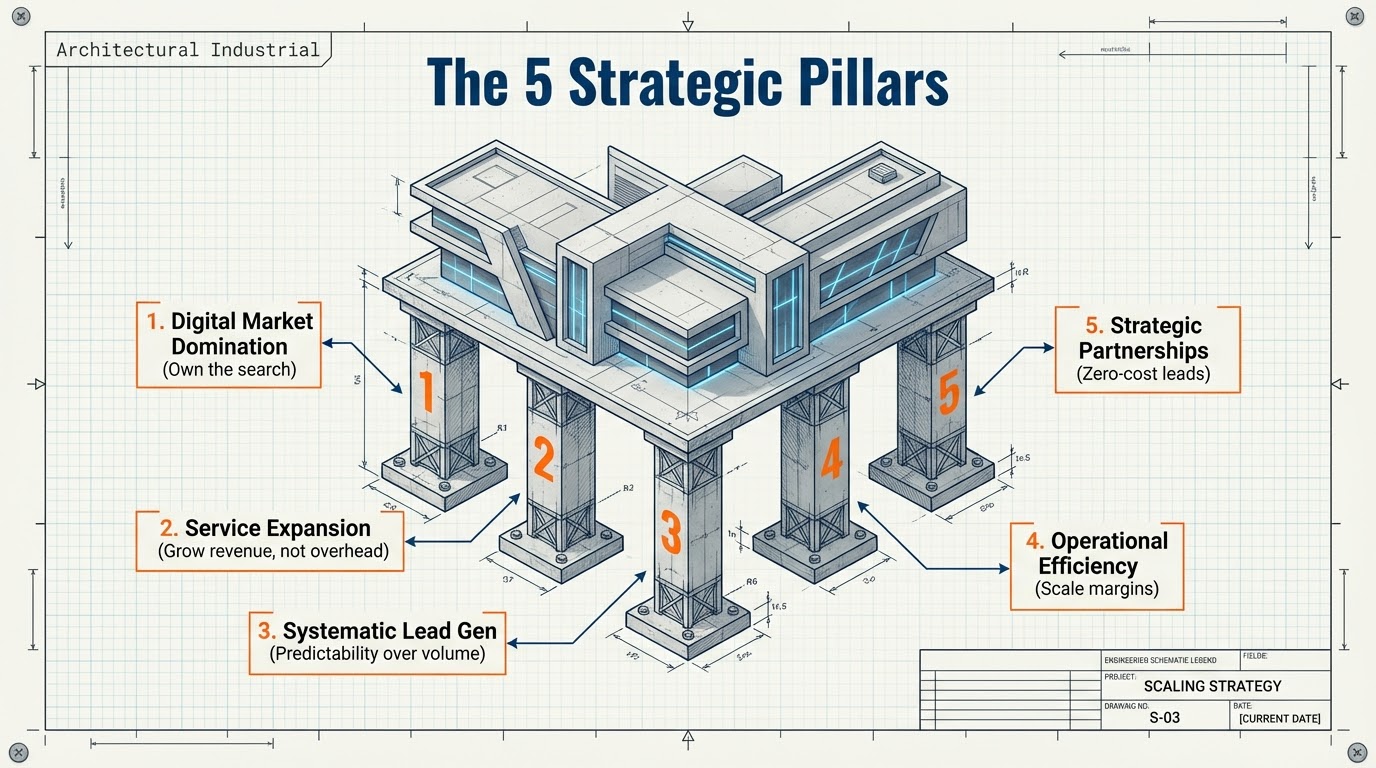
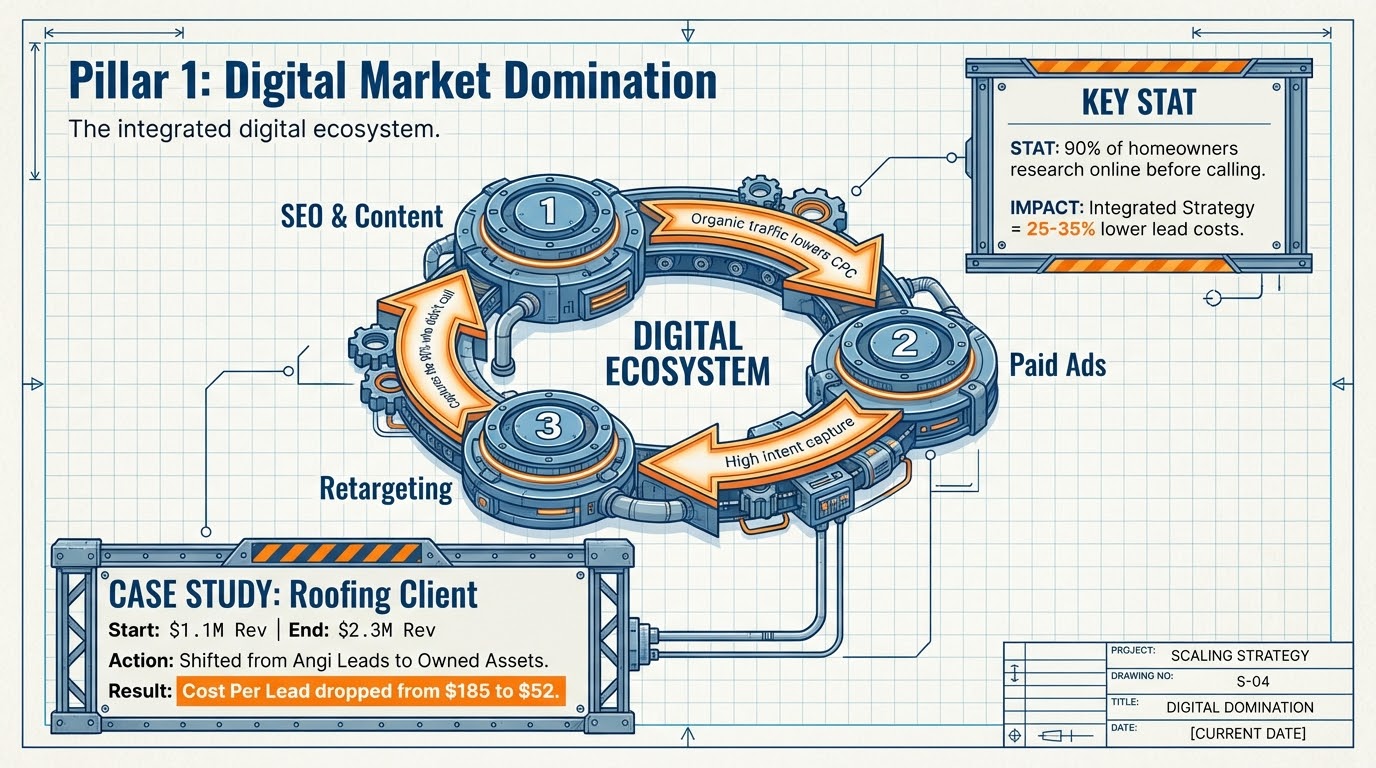
The data on this is unambiguous: 90% of homeowners research contractors online before making contact. The contractor who shows up consistently across search, maps, and paid advertising captures a disproportionate share of the market — not because they're better, but because they're visible when the decision is being made.
Each digital capability you systematically build compounds. We've measured this across our client base: contractors who integrate SEO, Google Ads, and Facebook Ads into a single coordinated strategy see lead costs drop 25-35% compared to running any channel in isolation. The channels feed each other — organic rankings reduce paid CPCs, retargeting converts organic visitors who didn't call the first time.
What digital domination looks like in practice:
One of our roofing clients — an Orange County contractor doing $1.1M when we started working together — hit $2.3M in revenue 14 months later. The single biggest lever was pulling them out of the Angi/HomeAdvisor dependency and building an owned digital presence. Their cost per exclusive lead dropped from $185 to $52
 Pillar 2: Service Expansion Strategy — Grow Revenue Without Growing Overhead
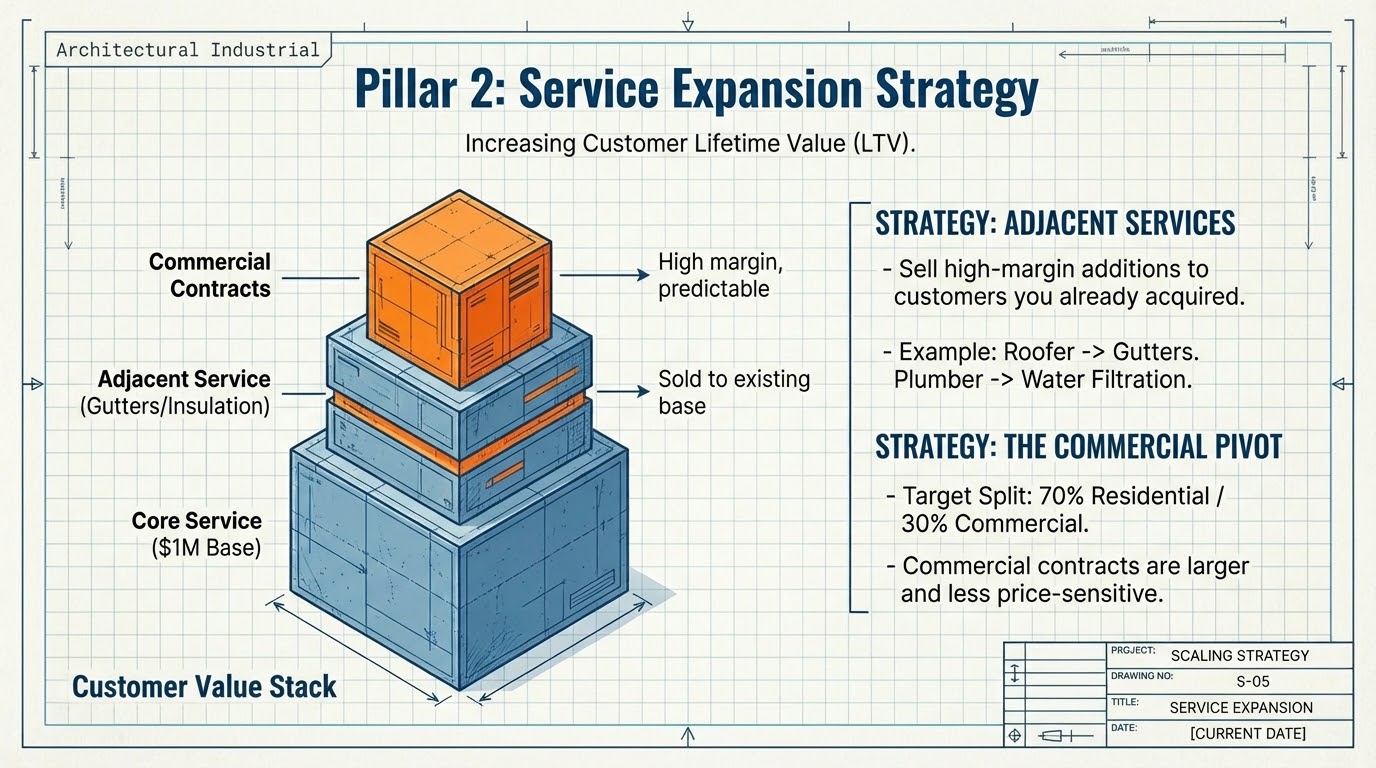
The fastest path from $1M to $3M is almost never doing more of the same work. It's doing higher-margin work, recurring work, or complementary work that serves the same customer base you already have.
A residential roofing contractor doing $1M has customers who also need gutters, attic insulation, and exterior painting. A plumber has customers who need water filtration, water heaters, and drain maintenance contracts. The infrastructure — trucks, insurance, relationships — is already there. Adding a complementary service line to an existing $1M customer base can add $300-500K in revenue with minimal additional overhead.
The expansion sequence that works:
Commercial work deserves special attention here. The shift from residential-only to a 70/30 residential-commercial split is one of the most reliable ways to improve margins while growing revenue. Commercial contracts are larger, more predictable, and less price-sensitive than residential work competed through lead aggregators.
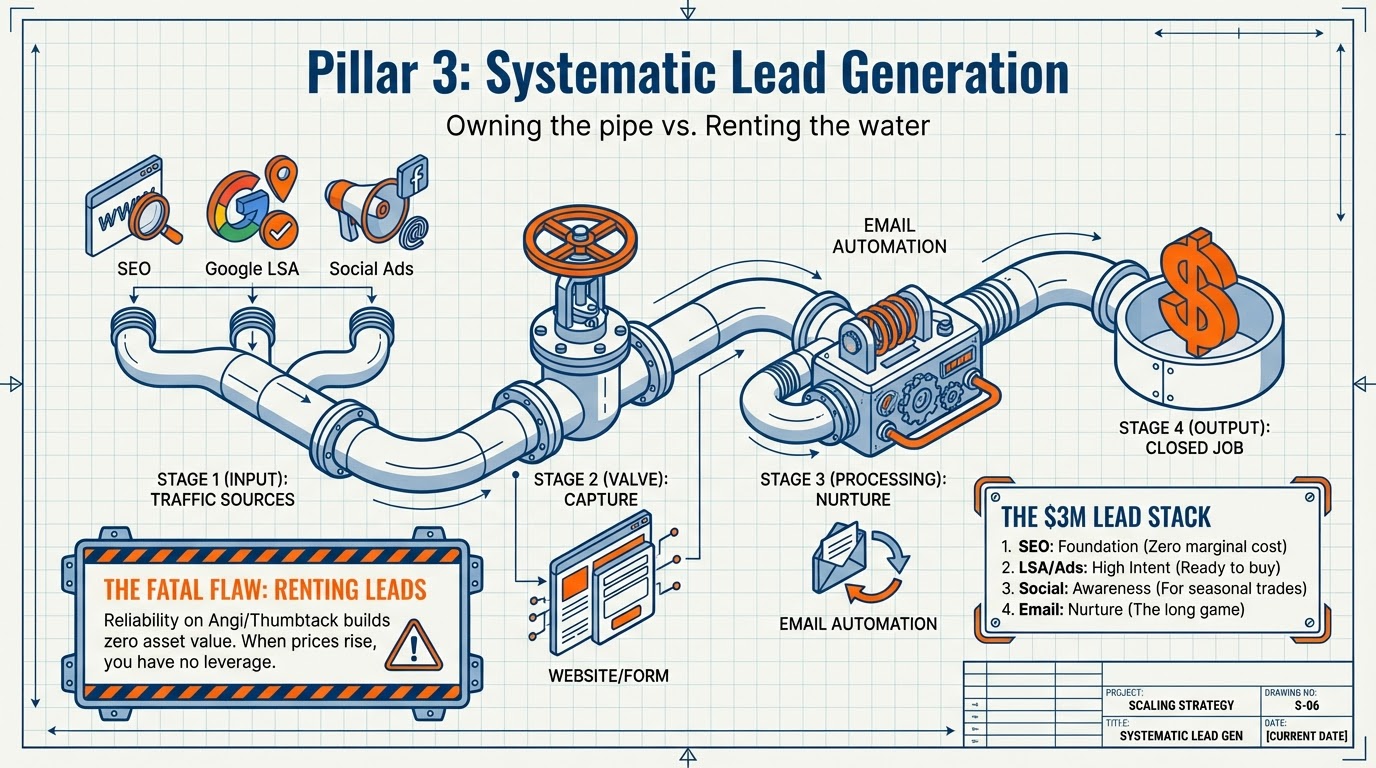
The defining characteristic of a $3M contractor versus a $1M contractor is predictability. Not more leads — predictable leads. A contractor doing $3M knows within a reasonable range how many leads are coming in next month, what they'll cost, and what they'll close at. A contractor doing $1M is often one slow month away from cash flow stress.
Building a predictable pipeline requires owning the lead generation infrastructure, not renting it from Angi, HomeAdvisor, or Thumbtack. Renting leads is an acceptable short-term tactic. It is a fatal long-term strategy because you never build the asset — the audience, the brand, the SEO authority — that makes leads cheaper over time instead of more expensive.
The lead generation stack for $3M contractors:
The contractors scaling fastest have all five running simultaneously, with attribution tracking that tells them exactly which channels are producing the best leads — not just the most leads.
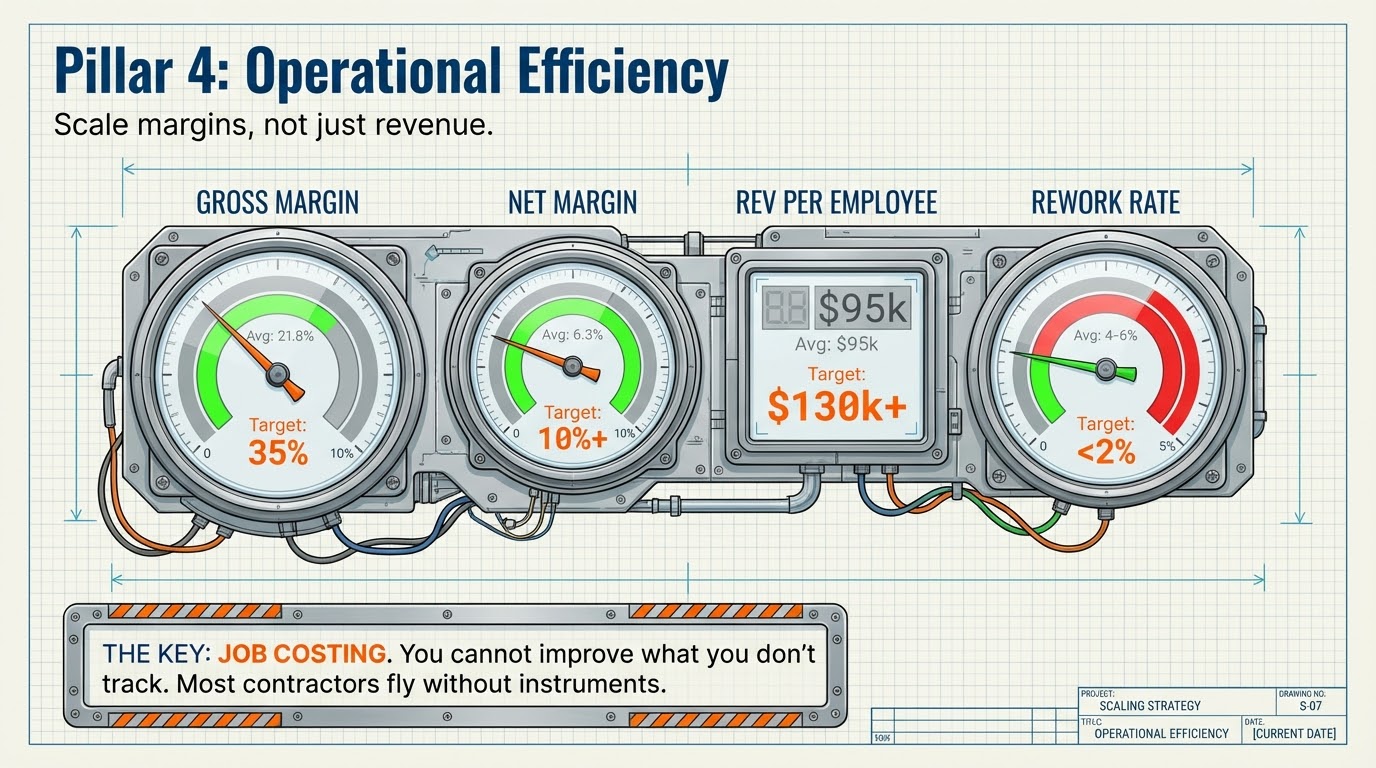
Revenue without margin is a trap. The industry average gross margin for contractors is 21.8%. Best-in-class operations run at 28-35%. That gap — 6-13 percentage points — represents the difference between a contractor who is perpetually cash-strapped at $2M and one who is profitable and fundable at $2M.
The margin improvement that matters most at the $1M-$3M transition is job costing. Most contractors at $1M are estimating from experience rather than data. They know roughly what a job should cost but can't tell you the actual labor hours per square foot, actual material waste percentage, or actual subcontractor markup after the fact. Without job costing data, you cannot improve margins — you're flying without instruments.
The operational metrics that predict scale:
MetricIndustry AverageBest-in-Class$3M TargetGross margin21.8%35%+28%+Net margin6.3%11.9%10%+Revenue per employee$95K$160K+$130K+Rework rate4-6%Under 2%Under 2%
Getting from average to best-in-class on these metrics doesn't require cutting — it requires measurement, then systematization. You cannot improve what you don't track.
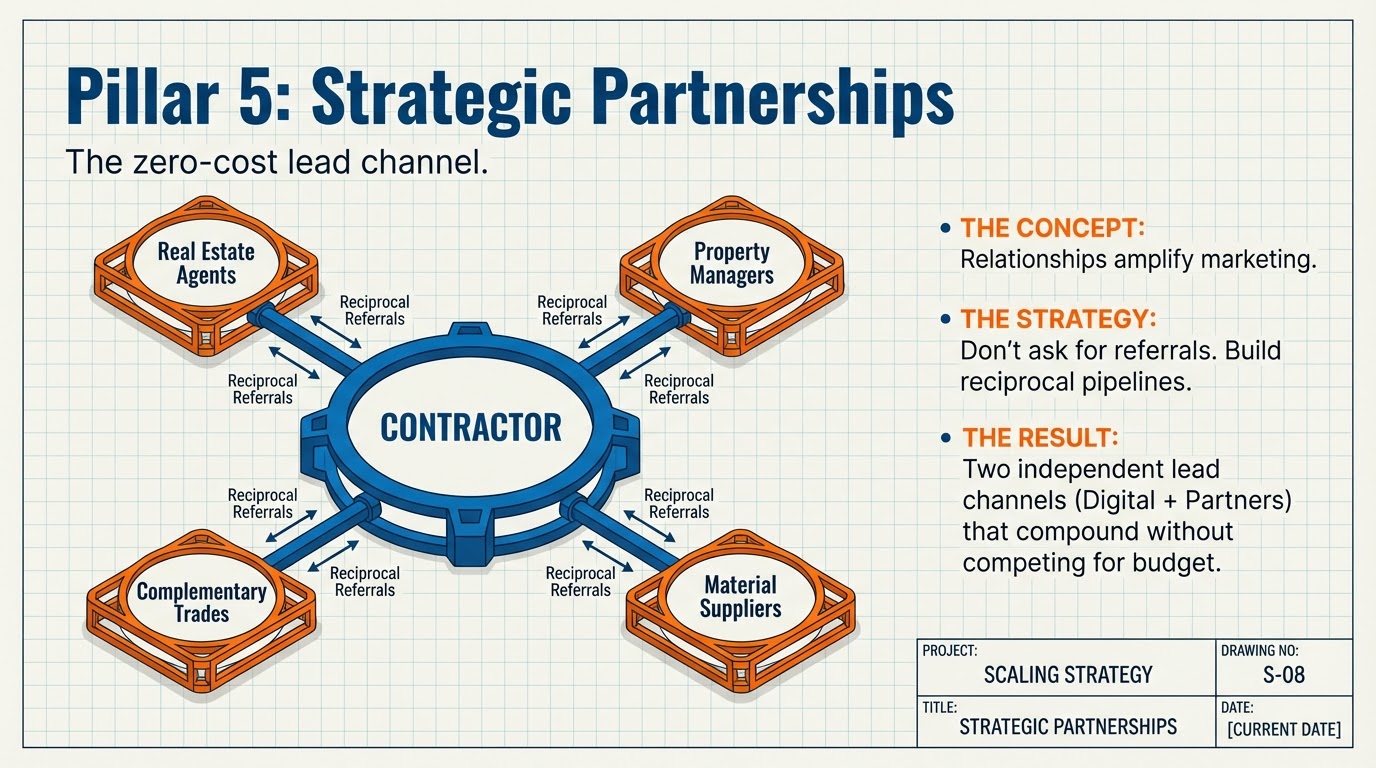
The fastest growth often comes not from marketing spend but from strategic alliances that put you in front of qualified buyers without a cost-per-lead. For contractors, the highest-value partnerships are typically: real estate agents and property managers (consistent referral volume), complementary trade contractors (reciprocal referrals), commercial property developers (access to project pipelines), and material suppliers (preferred vendor relationships with co-marketing opportunities).
These relationships don't replace digital marketing — they amplify it. A roofing contractor with three active real estate agent referral relationships and a strong SEO presence is building two independent lead channels that compound without competing for budget.
Goal: Establish systems and baseline metrics before you accelerate
Before adding any marketing spend, document your current operations. Where are jobs losing margin? Where is the owner's time going? What does your actual cost-per-lead look like across all channels? You cannot build a $3M company on a foundation you haven't measured.
Revenue target: Maintain $250K/quarter baseline while building infrastructure
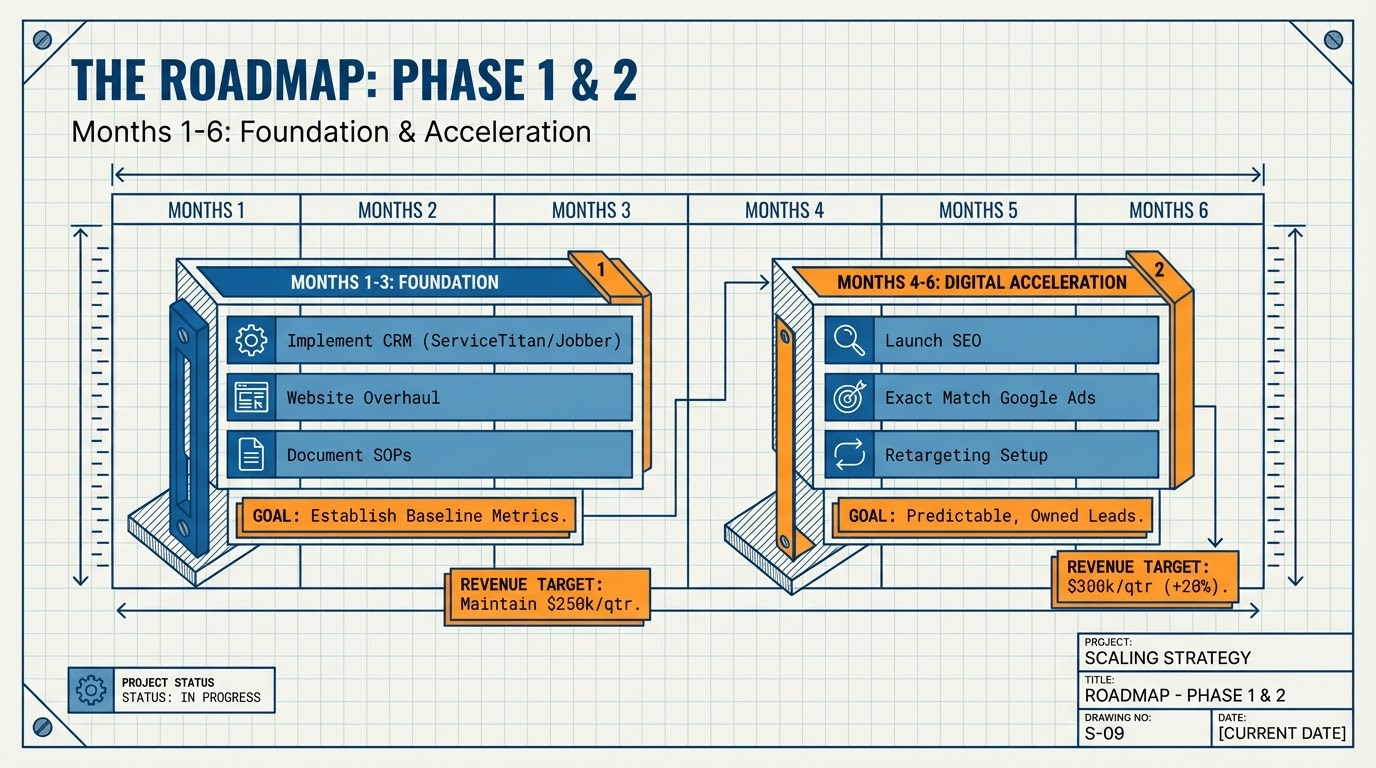
Goal: Build predictable, owned lead generation
With systems in place, now accelerate acquisition. Launch SEO targeting your highest-value service and city combinations. Start Google Ads on exact and phrase match keywords only — broad match at this stage will drain budget. Launch Facebook retargeting for website visitors. Implement email sequences for leads who didn't convert immediately.
Revenue target: $300K/quarter — 20% increase
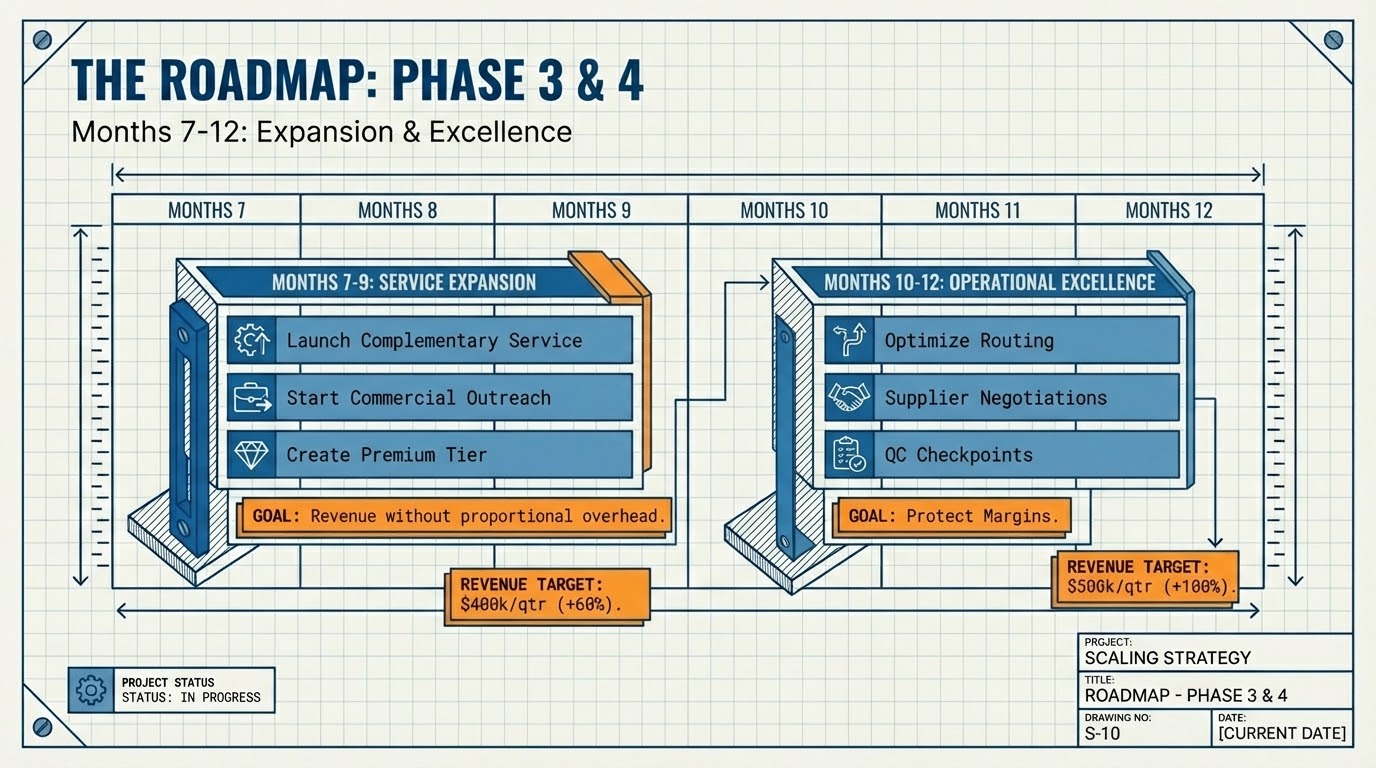
Goal: Add revenue streams without proportional overhead increases
Identify and launch one complementary service line or begin targeting commercial work. Use your existing customer base as the initial market — they already trust you. Develop a maintenance contract offering for at least one service. Create a premium service tier with a 15-25% price premium justified by guarantees, response time, or warranty terms.
Revenue target: $400K/quarter — 60% increase
Goal: Protect margins as volume increases
Growth exposes operational cracks. This quarter is about reinforcing the foundation before the final push. Optimize scheduling and routing to reduce drive time. Negotiate improved terms with your top three material suppliers — volume justifies it now. Get rework under 2% through quality control checkpoints. Review job costing data from the first year and identify the three highest-margin job types to prioritize.
Revenue target: $500K/quarter — 100% increase
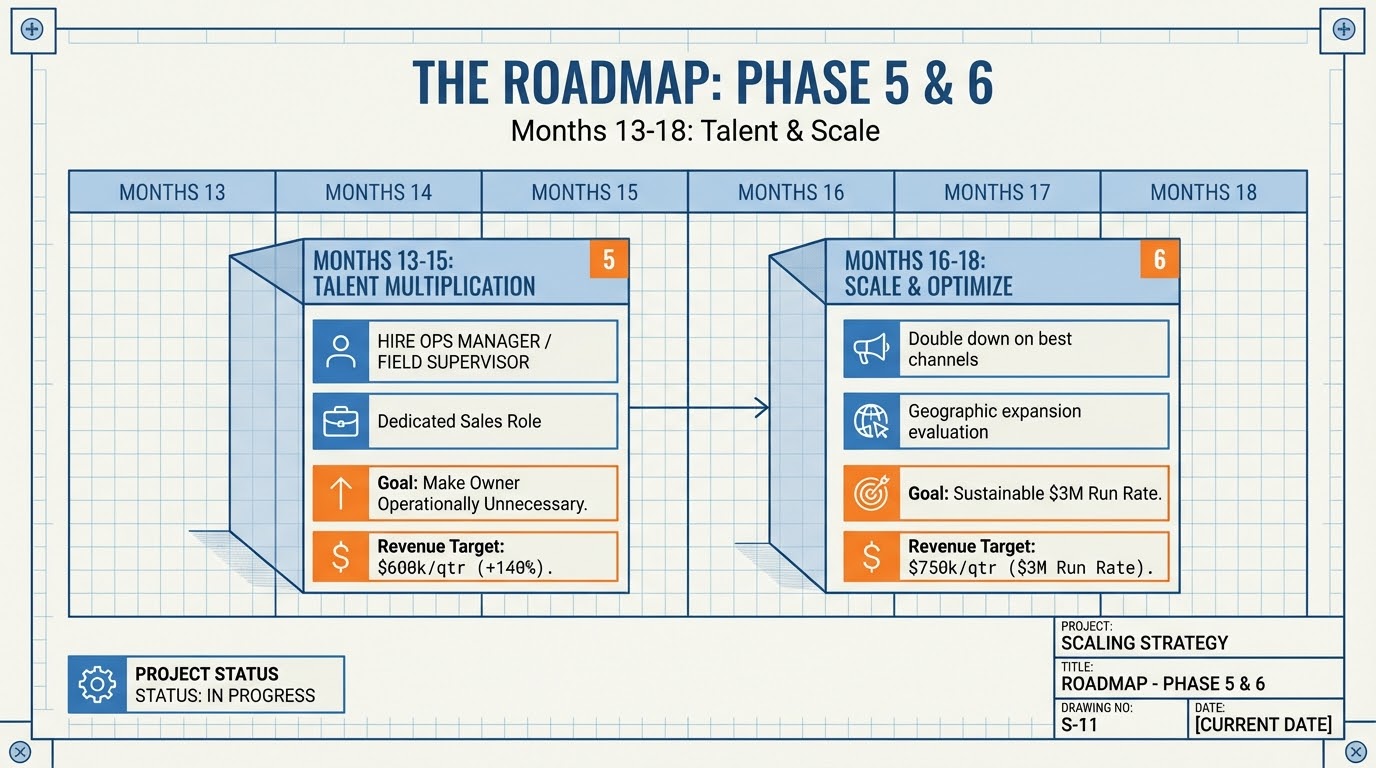
Goal: Build the leadership layer that makes you operationally unnecessary
This is the hardest phase for most contractors. Hiring an operations manager feels expensive when you've been doing it yourself. It is the investment that makes every other investment pay off. Without someone managing day-to-day operations, the owner remains the bottleneck and the ceiling stays at $2M regardless of lead volume.
Hire: Operations manager or field supervisor, dedicated sales or estimating role, and an office coordinator if not already in place.
Revenue target: $600K/quarter — 140% increase
Goal: Achieve sustainable $3M run rate
You've built the infrastructure. Now maximize it. Double down on the marketing channels producing the best leads. Evaluate geographic expansion only if your systems are genuinely replicable in a new market — expanding operations before processes are stable is one of the most common ways contractors derail at this stage.
Revenue target: $750K/quarter — 200% increase
Ryan Goering founded BaaDigi after watching skilled contractors get outmarketed by inferior competitors with better digital infrastructure. As a former Marine and entrepreneur, he built BaaDigi around a single principle: contractors should own their growth engine, not rent it.
What we bring to the $1M-$3M transition:
We've managed over $2.3M in contractor advertising spend across Google, Facebook, and Instagram. We know what a $45 roofing lead looks like versus a $180 one, what HVAC seasonality does to Facebook CPMs in Southern California, and why most contractor Google Ads campaigns hemorrhage budget on broad match keywords the agency never reviews.
Our clients don't get a generic marketing strategy. They get a system built around their specific trade, market, and growth stage — with attribution tracking that shows exactly which dollars are generating which leads.
Our approach:
If you're at $1M and want to be at $3M, the question isn't whether the blueprint works. It does. The question is whether you're ready to execute it.